
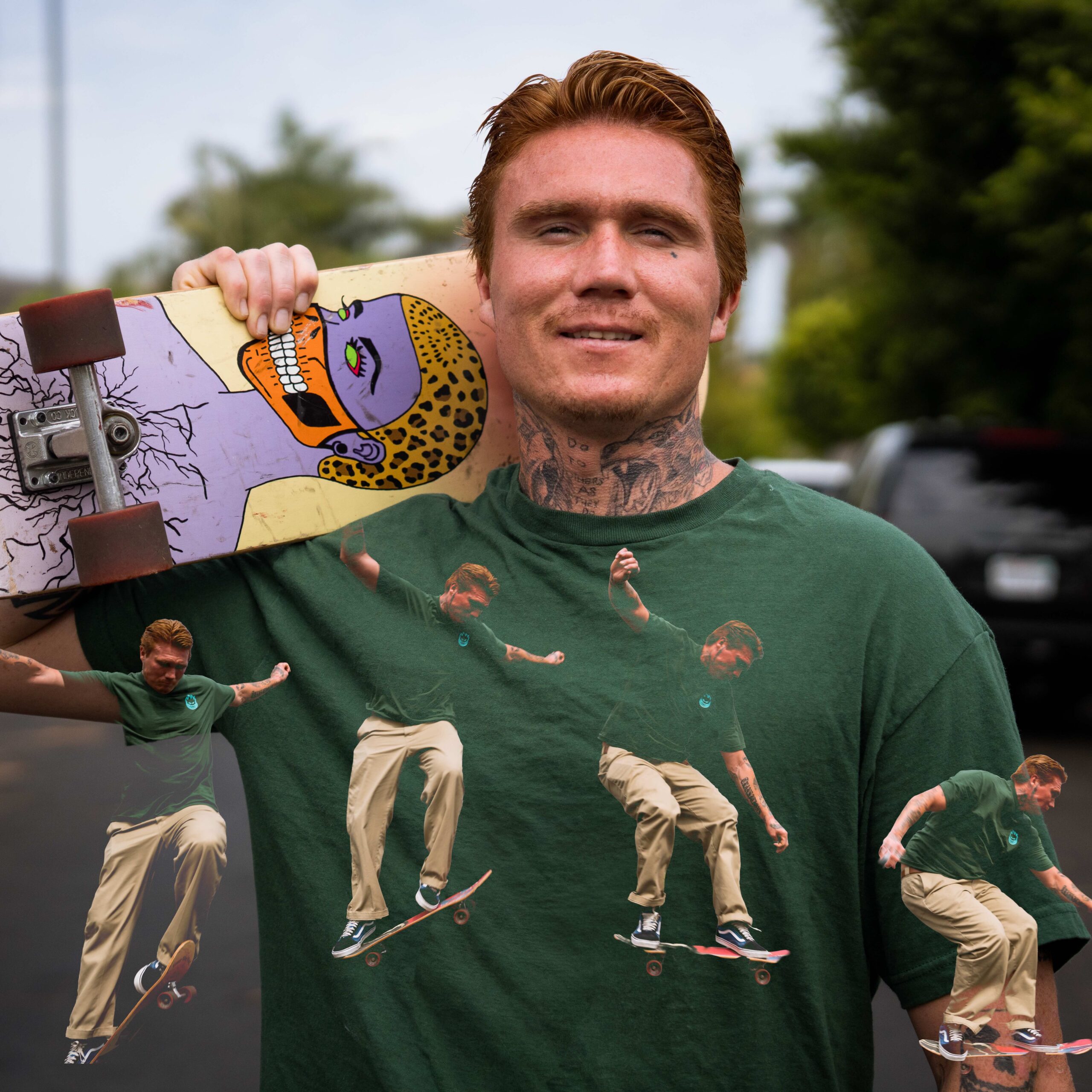
Jordan “Red” T. was supposed to become a professional skateboarder. Instead, addiction nearly killed him, a piece of his skull ended up outside of his head, and he tried to escape the hospital with an IV still attached so he could go get drunk. Somehow, that still wasn’t the end of the story.
The nickname of “Red” came because he was the redheaded white kid growing up in the projects of San Pedro, California—a distinction that, as a child, occasionally required him to prove he could take a punch. “I lived in the projects and was the only white kid there, so I had to fight a lot to show I wasn’t scared,” he remembers. Eventually, the same neighborhood kids he’d been fighting started to like him. Then, one day, they brought nine-year-old Red to Channel Skate Park. They eventually went home. Red didn’t. That was basically it.
“I got addicted to it immediately.”
Wheels on concrete, scraped knees, repetition, frustration, and the experience of finally landing something you’ve fallen trying to land fifty times. Skateboarding gave Red something he had been desperately looking for before he was old enough to know what to call it. Silencing all of the noise in his head.
“I would think about everything—Where is my dad? Why is mom struggling so much? How can I help?” Then he got on a skateboard. “I would just think about trying to land the next trick.” No family chaos. No fights. No existential crisis happening inside the brain of a nine-year-old.
Just the board. The trick. The concrete. Try again.
By seventeen, people weren’t just watching Red skate—they were filming him.
People started asking if he wanted sponsors (skate companies representing him). Suddenly, the kid who had wandered into the skate park had evidence that this thing might actually take him somewhere. His career plan at seventeen was refreshingly uncomplicated. “Pro skater. That’s all I wanted.” And he was good.
Good enough to get noticed. Good enough to get sponsored. Good enough that people wanted to watch him skate. For a kid who had spent a lot of his childhood fighting, being watched because people liked what he was doing felt different. “It felt good to know I was making other people happy just by watching me skate.”
But success came with its own extracurricular activities.
Beers showed up. Parties showed up. After competitions like the U.S. Open, there were backyard bowls, alcohol, drugs, and a crowd of people who were always ready to keep the night going. Before skating success, while his father was in prison and his mother was struggling to pay the bills as a single mom, Red had started experimenting with alcohol and inhalants. “There’s something about me and being in my head.”
Skateboarding had once solved that problem. Then substances offered another solution. The difference was that one gave him a life. The other slowly started taking it. People around him noticed before he did. Skaters who were winning contests pulled him aside. “When you’re not drinking, you’re great,” they told him. “If you want to become the best, you’ve gotta cut that shit out.”
Red did what young people throughout human history have traditionally done with excellent advice: He ignored it.
At one point, Red was riding for Santa Cruz Skateboards. Boards came in. Clothes came in. Opportunities were sitting directly in front of him. He just didn’t understand how good he had it. Instead of thinking about how to turn momentum into a career, he was thinking about going to the bar.
Eventually, Santa Cruz started “running out of boards.”
Translation: “Red, buddy, we’re breaking up with you.”
Then skateboarding—the thing that had defined him since childhood—started disappearing from his life almost entirely. He found himself at Venice Beach, drunk, roaming around looking for drugs and hanging out with whoever happened to be there. And Red developed one particularly bleak habit. He kept losing his skateboard. Sometimes he would hide it underneath a trash can, assuming Future Red would eventually sober up, retrace the movements of Drunk Red, locate the correct trash can somewhere in Venice, and recover his board.
This was not an especially reliable filing system.
His life became cyclical. Drink and drugs for days. Come out of it. Detox. Skate. Feel better. Start drinking again. Rinse and Repeat.
He estimates he went to detox somewhere around fifteen or twenty times. Then, finally, something worked. Red entered a program, moved into sober living, got a sponsor (the sobriety kind), went to meetings and—possibly the most radical development of all—actually listened to what people were telling him. Nine months passed. Nine months sober. For Red, it felt enormous.
“I think this is it, Jordan,” he remembers telling himself. “You’re not gonna fucking drink anymore. You’ve got nine months. You’ve never had nine months in your life.” He thought the war was over. He thought he had won. He hadn’t.
Red got back together with a girlfriend. Things were good. For approximately five minutes. Within days, the relationship was back to constant arguments. Red had also started drinking non-alcoholic beers, which, for him, felt less like a sobriety tool and more like standing outside a bakery licking the window. After another argument, he decided to drink. Nine months disappeared.
He got drunk, found drugs, and spent roughly four days outside of reality. After about a day, he says, psychosis set in. He thought people were after him. He was seeing things. He would briefly snap back into reality and then disappear again. He was basically living at the skate park. Somewhere underneath the drugs and paranoia, he understood what was happening. He knew he was destroying everything again. And at that point, he says, he simply accepted it.
At the skate park, he was talking to friends and needed to borrow someone’s phone. Suddenly, Red fainted. He fell backward from the top of the ramp, nine feet down, toward the bottom of the skate pool, and slammed his head into the concrete. The world went black. His friend ran for the lifeguards.
They saved his life.
Red says Narcan was administered and believes he overdosed. According to what he was later told, multiple substances were in his system, including alcohol, methamphetamine, cocaine, and acid. He spent months in the hospital. Two weeks of them in a coma. His family gathered around his bed, believing they might be saying goodbye.
His head was severely swollen. “They said I looked like an alien.” Which is objectively a rough review to receive upon returning from a coma. But eventually memories started coming back. So did the reality of what had happened. And with it came one of the hardest realizations of Red’s life:
“Eventually I remembered that it wasn’t anybody else—it was me.”
The injury was catastrophic. Red underwent surgery involving the removal of part of his skull. He says a friend later told him he had seen the skull stored in a container and wheeled off to a freezer. A freezer?! He needed two surgeries, including one to put his skull back into place.
You might imagine that waking from a two-week coma after nearly dying from drugs and alcohol would produce an immediate, cinematic revelation.
Sunlight pours through the hospital window. A single tear falls. The protagonist whispers, “I choose life.”
That is not what happened.
Red tried to escape. He wanted a drink. So, while recovering from catastrophic head trauma, wearing a protective helmet and with an IV still in his arm, Red ran out of the hospital. He made it all the way to a bus. His intended destination? Venice Beach. His intended activity? More alcohol. More drugs. “I was ready to go to Venice Beach and get drunk and do drugs again because I didn’t want to think about the fact that this even happened.” It is one of the darkest moments of his story, but also perhaps the clearest illustration of addiction’s absurd brutality.
There is rock bottom.
And then there is boarding public transportation with exposed medical equipment after brain surgery because rock bottom apparently had a basement.
Recovery wasn’t instant. During his second month in the hospital, Red was already trying to walk even when staff didn’t want him getting out of bed. Talking was harder. Words he knew were somewhere inside his head simply wouldn’t come out. But he kept improving. He calls it a miracle.
Then came another fear: skateboarding. Had he destroyed that too? Red reached out to his sponsors and told them what happened. He took responsibility. The response surprised him. “Yeah. What’s your address, man? We’re here for you.”
Boxes arrived from OJ Wheels and other companies. People weren’t calling to lecture him. They were happy he was alive. They were happy he was skating again.
And Red was starting to understand exactly how close he had come to losing all of it. Especially his family. He talks about his mother differently when discussing the hospital. “I feel the worst for her,” he says. “I’m her firstborn son. To see your son going through that and think he’s going to pass away must have been so hard for her.” Then he says something quieter. “I’m still here, so she can sleep at night knowing her son is here.” Mortality is no longer an abstract concept for Red.
“Life is precious,” he says. “It’s a precious thing to have, and you can’t just take it for granted.”
He also wears a helmet now when skating. This is one lesson he would strongly prefer other skaters learn without first having part of their skull removed. “You’re falling on concrete every day,” he says. “Just wear a helmet.” Fair enough.
This time, since admitting to Beit T’Shuvah, Jordan is recognizing that recovery is about more than abstaining. It’s about responsibility. Red doesn’t soften his role in what happened. “Everything I’ve loved and cared about was being taken from me because of me. I’m the one who did this.” Nobody forced him to drink, he says. Nobody forced him to use drugs. “I chose to do it.” That accountability has become central to what he’s learning in rehab. “Take complete responsibility for yourself and be kind to others.” It sounds simple. Living it is harder.
Red says the seduction of addiction is that people remember the beginning—the fun, the parties, the first drink—and conveniently ignore where the road can lead. What was he trying to escape all those years? His answer is only two words. “Escaping reality.” Now he is trying to stay in it.
He prays. He thinks about his family. He thinks about the man he wants to become. He wants his mother to be able to look at him and see a son who is sober, alive, free, and finally doing what he is supposed to be doing. And, inevitably, he thinks about skateboarding. Because beneath the alcohol, the drugs, the sponsors, the detoxes, the coma, the surgeries, and the spectacularly ill-advised bus ride, there is still a nine-year-old kid at the skate park. “That’s me. That’s who I am,” he says. “I’m never gonna stop being a skateboarder. That’s for life.”
He dreams about returning to Channel Street. Venice. The homies who watched him grow up. He wants them to see him now. Drunk Red. Not Red disappearing for days. Just Red. Board under his feet. Clear-headed and focused. Trying to land the next trick.
“Skateboarding sober is completely different than skating drunk,” he says. “Skating sober is being focused on landing your trick, listening to your music, and having fun.” In other words, exactly what skateboarding was before everything got complicated.
Ask Red what he would tell a kid stepping onto a skateboard for the first time, and his advice isn’t particularly philosophical. “Just have fun.” Practice. Learn tricks. Fall. Get back up. Hang out with your friends. Do it again tomorrow.
“In order to chase your dreams, every day you have to work for it.”
There is something almost perfect about where he wants to end up. Back to the kid whose entire universe could shrink down to four wheels, a piece of wood, and one trick he hadn’t landed yet.
There’s a pretty undeniable correlation between skateboarding and recovery from addiction. Neither is linear, neither is graceful, and both can get messy as hell. Sometimes you make a mistake and fall. But success was never about never falling—it’s about what you do afterward. You get back up, find your footing, and try again. And for Red, that means getting back on the board—this time, sober.