
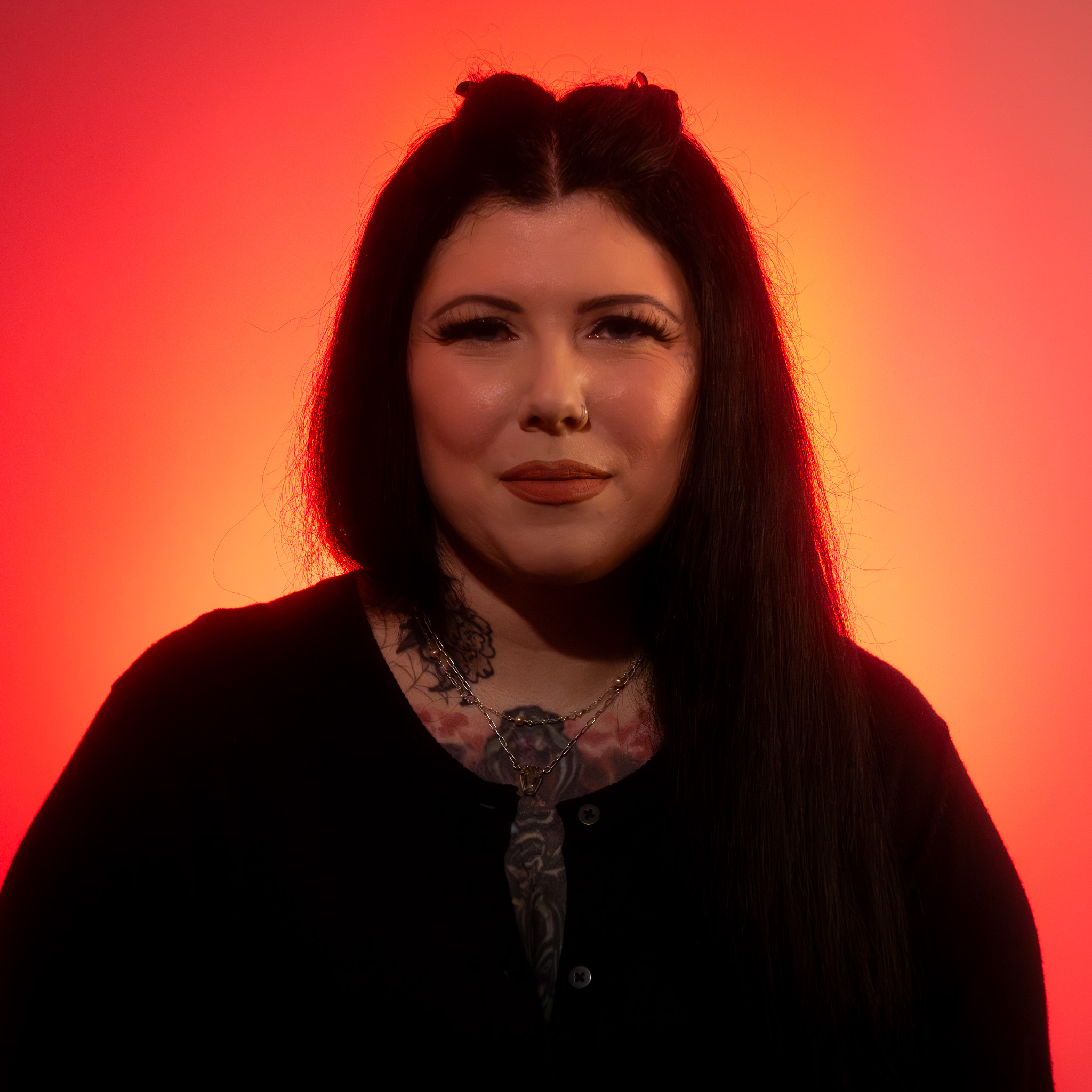
When your soul—your truth—is stuck behind a deadbolt, what’s left is only the wisps that can slip through the cracks. In the case of Charlie R., more than just her emotions were locked behind closed doors—she was—literally. At just the age of “Timeouts”, as her mom called them. All because her daughter was too “hyper”. Charlie remembers it differently. “I just wanted her attention. And she didn’t want to give it to me or didn’t have the capacity to.”
One day, in an attempt to escape her room, Charlie put her hand through her bedroom window. She was screaming, crying, bleeding everywhere, and nobody believed her. When her father finally came home from work and they opened the door, there was blood all over the floor. “They put me in the psych ward at six years old, UCLA psych ward, saying I tried to kill myself…I was terrified. That’s one of my first memories.”
Yet, when she describes herself, one word comes to mind: “Resilient. I’ve been through a lot of shit, and I feel like I have outlived my nine lives, but I’m still here.”
She grew up an only child in Van Nuys, in a house so picture-perfect that productions shot there constantly: commercials, episodes of Law & Order. Once, an alt-rock band filmed their first music video on her block, a story about what goes on behind the white picket fence, where the parents lock their daughter in the closet. “That was my life story happening parallel to them filming this music video.”
Her father was a hotshot realtor, whose life revolved around houses, yet he was never home. Her mother was a celebrity clothing stylist who brought Britney Spears, NSYNC, and the Backstreet Boys through Charlie’s childhood. Bragging rights, and yet, the one big hang-up was that her mom was also a severe alcoholic. “I’ve never known her sober in my life.” Once, in a drunken stupor, her mother threw a ceramic plate at Charlie’s face and split her lip wide open, then called in her own plastic surgeon and paid him privately to stitch her daughter up in the ER so CPS wouldn’t get involved.
Therapists came and went; any time one suggested the parents might be part of the problem, they were fired. Schools came and went for the same reason: three elementary schools, a few middle schools. “They could never have the finger pointed at them.”
Then, at six or seven, during bathtime, her mother noticed red dots covering Charlie’s body “like a leopard,” broken blood vessels everywhere. By that night she’d been admitted to the oncology ward at Children’s Hospital Los Angeles, diagnosed with ITP, an autoimmune disorder that left her blood almost unable to clot. There was no cure. For six years she went in once a week for infusions that bought her two days at a time. She had to be homeschooled and could not participate in any activity where she could get injured, because getting hurt meant bleeding internally. Another room. Another lock.
She made a friend in that children’s cancer ward, Cami, a little girl with leukemia who lived at the hospital, and Charlie always asked to be her roommate. One day she checked in, and Cami was gone. “That’s when it got real for me, like, ‘Oh, I could die.'” She still has the bracelet they made in Cami’s memory. Her mother, to her credit, and Charlie gives her that credit freely, hunted down the best doctors in the country, and eventually a study out of Weill Cornell in New York saved her. It’s the standard of care for her disorder today.
“It was the most painful, scariest thing I’ve ever done in my life, but it cured me. So I was a part of medical history.”
When she was finally let out into the world, she was dropped halfway into tenth grade at a private school in North Hills. After missing most of middle school, she had no idea how to navigate the social dynamics of high school. “I was so sheltered. I couldn’t have play dates or anything because my mom and dad were afraid I’d get hurt. So I just ran with the bad kids immediately. That’s where I found comfort.” By 16, she was raving in warehouses downtown by Skid Row with a fake ID and people twice her age. By 17, her parents had her abducted in the middle of the night and dragged to a lockdown boarding school in Temecula. “I was terrified. I thought I was being kidnapped. I had no fucking idea.” In a real sense, she was.
It was, in her words, “a super abusive environment, and any time a kid called home to say so, staff hung up the phone.” So just before her eighteenth birthday, Charlie planned her escape. When the girl she was scheming with told on her, the plan was accelerated. Charlie ran. Facing a barbed wire fence, the pajamas she didn’t have time to change out of, ripping more and more with every movement. Razor wire cutting deep into her skin. Once over the fence, bloodied freedom came with a choice. One way was a police station that would bring her right back, and the other was vast empty fields for miles. She chose the fields, and into the darkness she ran.
Eventually, she stumbled upon a gas station, home to some all-American bros and their lifted truck. She hopped in and went with them to her first “American Pie house party.” That night, she slept on a stranger’s couch that turned out to be on the other side of the school’s concrete wall. “I was spending the night right next door to my school while they were looking for me.” A friend picked her up the next day, and she couch-hopped until she turned 18 so no one could send her back. Her parents, by then in the middle of a divorce, barely noticed.
Free at last, or so she thought, she went all the way out. Coke, ketamine, ecstasy. “Just all the rave drugs. That’s where my addiction started.” She promoted raves and go-go danced at them, a “candy kid” with brightly dyed hair. “I was a raver. I loved it.” Out of the perfect cocktail of love and guilt, dad paid for an apartment in Hollywood, and she drifted from the rave scene into the West Hollywood gay scene, figuring out who she was. When she came out as gay, her family took it in stride. “It was no big deal, which was really nice because not everyone has that story.”
Then her first serious girlfriend brought her to her parents’ horse-ranch mansion in Orange County for a Fourth of July party. Charlie found her bedroom door locked and banged on it until it opened, and once she was inside, the door quickly locked behind her. They were smoking meth. “I did it, and my soul was sold in that moment. I can’t even fucking tell you how it felt.” The girlfriend’s parents, it turned out, were major meth dealers. The supply was endless. For four years Charlie barely put the pipe down, and at five-seven she dropped to a hundred pounds. “I was a walking skeleton.” Because she never paid for any of it and never lost a thing, there was no bottom to hit. “I didn’t really understand the gravity of how bad my addiction was because I was still living in a mansion in Orange County or a Hollywood apartment, had everything I needed.”
One day, while in the Hollywood apartment, there was a knock at the door. A hard knock—which was strange, because there was a gate code between the street and her door. It was the DEA. They forced their way in and demanded to know where the drugs were hidden. Luckily, all of the meth was freshly smoked. Eventually, they left. Charlie found out later that, despite their jackets and badges, they were, in fact, not DEA agents. “It turns out that they were jealous friends of the parents that came to rob me because we were the drug princesses.” These men had been watching her for who knows how long. Waiting for their opportunity. Charlie was rightfully terrified for her life.
When the meth would wear off, the relationship would turn physically violent, and when Charlie finally left, she went to her first rehab.
What followed was more than a decade of in and out: dry stretches to appease other people, AA meetings with no sponsor and no steps. One of her best friends from the party years died of a fentanyl overdose, and Charlie was the one who found her in the bathtub and pulled her out. This shattered Charlie. Added another brick to the wall.
Then came Kratom, a synthetic opiate you can buy at a smoke shop, introduced by an ex as a legal way to stay high. “I have done the pills, the extracts, the drinks, I mean anything, you name it. I got deep into Kratom.” It was the feeling she’d been chasing since that hospital bed. “Opiates were my love because I didn’t have to feel anything. All the pain and trauma in my childhood- I didn’t have to feel it.” The beautiful, dreaded relief of the opiate numb. The same one she had experienced when she was just a child in the oncology ward.
Eventually, she also started working in treatment. “I was familiar enough with AA to spit the game.” Treatment centers didn’t test for Kratom yet, so she’d slip out to her car for five-minute breaks, pop more Kratom, and walk back inside. “So I’m running groups on not to do drugs…while I’m high on drugs.” She told her partner it was all for leftover body pain from the ITP. When her partner caught on, Charlie went to rehab to save the relationship, bullshitted her way through it, graduated, and went right back to her old ways. Along the road, she and her dad were evicted, and in her thirties Charlie found herself living under her mother’s roof again, locking her own door every night.
The end came this past February, at a birthday party her partner threw for her. Kratom, a lot of tequila, a blackout. She fought everyone at the party. She ran into traffic. “Psychosis. Breakdown.” Her partner broke up with her and blocked her everywhere. “[It felt ] absolutely horrible. I was so embarrassed, so sad, and absolutely heartbroken.” That’s when she found Beit T’Shuvah. This time she didn’t go to treatment to save a relationship. “I went to treatment thinking I have to save my life. I can’t do this anymore.”
On her first day at Beit T’Shuvah, the community happened to be heading to the beach. On the drive back, Charlie was crying. “I was like, ‘Wow, this is nothing like any treatment center I’ve ever been to. I feel like I’m at home.'” She’d done the boot-camp programs, places built like prisons for children with ADHD, the grimy LA rehabs, and places where she was teased for being gay. Here, soon after she arrived, there was a Pride Shabbat. “That was a huge thing too, that LGBTQ are welcome here.” And nobody was hammering anything into her. “Beit T’Shuvah puts the power in your hands. It’ll give you what you put in.”
So she’s putting it in. “I’ve never worked a program. I’ve never had a sponsor as much as I’ve jumped in and out of AA. Now, I’ve got a sponsor and I’m working the steps.” She has commitments. She prays, something she’d never done. Now, she says, “I really feel like God has a plan for me.”
She’s making art, playing the guitar she brought with her, and writing again. You may have seen her name on the byline of some of our spotlights. Yes, this is THAT Charlie R. The incredible writer you have all been reading the work of for months is now the subject of one herself. “When I’m not high, I’m a very creative person, and when I’m high, I do not create. So being able to create again has been super healing for me.”
She has the job she wanted. She’s looking at apartments. Her partner is back in her corner. Her life is filled with love. Well-earned love, at that.
For most of her life, someone else held the key: her parents, a hospital, her drugs. But they say that when God closes a door, he opens a window. Well, when he locks one, Charlie kicks it the fuck down. Because, today, anything is possible for her. “For a long time, I didn’t think I would ever be able to do any of the stuff I’m doing now. This is just the beginning.” She pauses when you tell her she deserves it. “I don’t know. Maybe after everything I’ve been through, it’s finally my time.”
It is.