
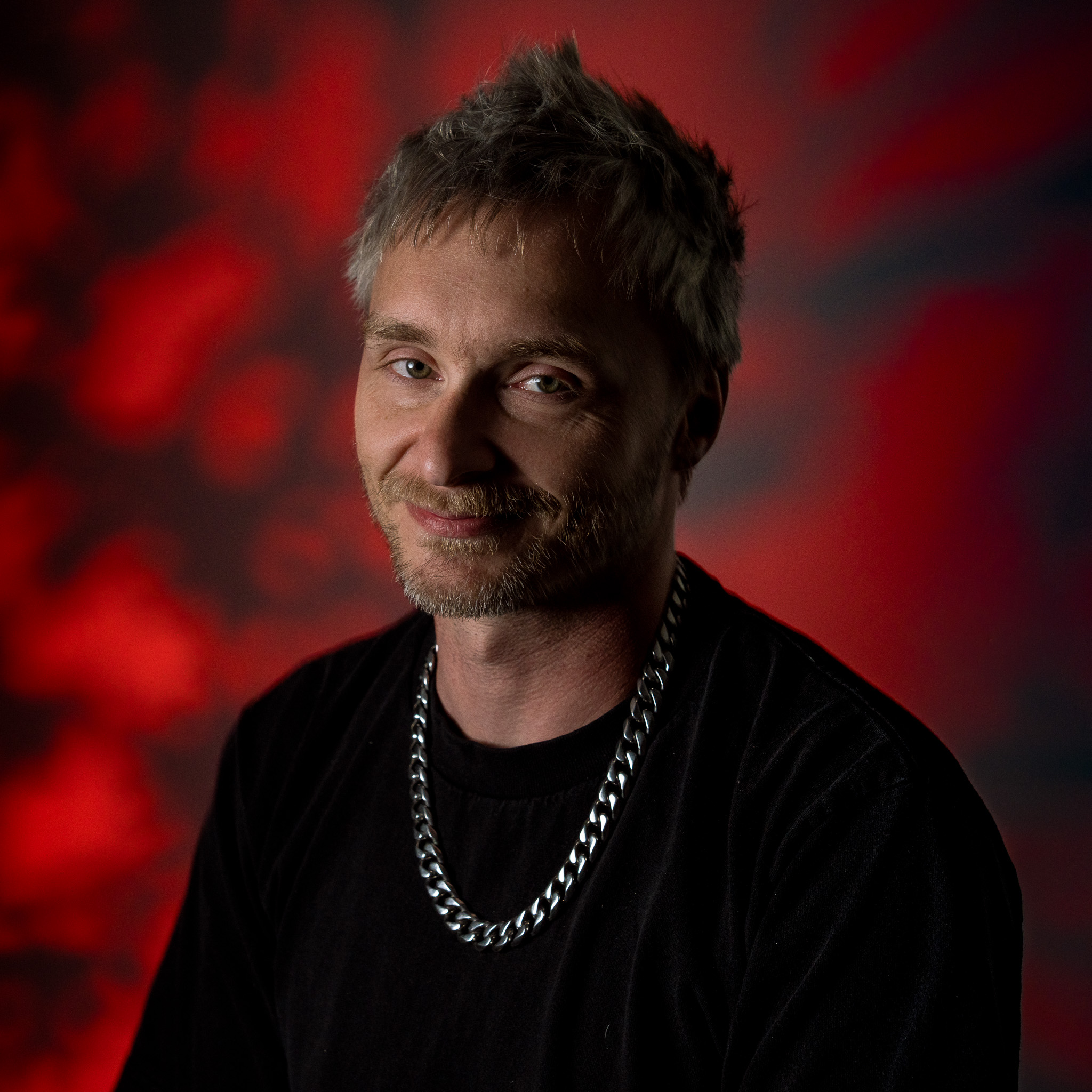
Mike brings light into the sanctuary far before a flame touches a candle. I’m not just talking about the stage lights on Shabbat, the string lights on Hanukkah, or the rainbow shimmering robotic spinning disco ball on Pride Shabbat—although he is the mastermind behind all of those as well. I’m talking about that warm glow that allows us to see each other for who we really are. For us to see him for everything he is. So, for once, let’s illuminate him—in this week’s spotlight.
There were 250 souls that lived in Vienna, Maryland—251 when Mike was born. The town was so safe that the only major crime that had been committed in 20 years was when someone tried to rob the only bank in town, and the unphased teller halfheartedly told the gunmen to just “get out of here.” In no other words, the frame around Mike’s childhood was idyllic. The painting inside, however, held darkness and turmoil. Making friends didn’t come easily to him. He was an awkward kid, and he knew it. He struggled to belong among children his own age, retaliating with sharpness when they laughed at him, which only made them laugh harder, which only made him sharper, a small, cruel cycle that left him, again and again, feeling ostracized and alone. Boy Scouts, youth group, junior high, spent silent in a room while everyone else already had their people, their cliques, their easy laughter. It didn’t matter what the room was—Mike sat in the corner of it, waiting for his mother’s car, and felt the particular loneliness of being surrounded and unseen.
That is, until Mike found his first love: theater. “That was my absolute lifesaver.” He joined a drama camp and, for once, he found purpose. “I could just put on a mask. I could put on some makeup and a costume and check out from who I was and play this character. It gave me the relief that I needed at that time to keep me moving forward because I had thoughts of suicide.” In the theater, for the first time in his life, Mike started to make friends. But still, there was something he was hiding from them. From everyone. From, most of all, himself.
He didn’t start to understand it until he was twelve or thirteen, and even then, understanding is too generous a word for what it was—more a flicker he couldn’t hold onto, a feeling he had no name for and no one to ask. “I didn’t know what it was, but I just knew I looked at boys the way boys looked at girls.” He didn’t think it was obvious, but would come to find out, decades later, that it was achingly obvious—that the people around him had somehow known before he let himself know. At nineteen, once he had realized his feelings, he started dating men more seriously. While on the phone with his mother after a boyfriend’s betrayal, he asked for dating advice. “Is this your way of telling me you’re gay?” she asked. “Yes,” he said, and wept. For years, he believed his mother’s quiet sadness at the news had been about him being gay—some private disappointment she’d never voiced. It wasn’t until family therapy at Beit T’Shuvah, decades later, that he learned the truth: she wasn’t grieving who he was. She was grieving how much harder the world was about to become for a boy who already struggled to find his footing in it. Not because she loved him less. Because she loved him enough to already be afraid for him.
At this point in Mike’s life, he lived in Ocean City, Maryland, with his grandparents. The occasional pot smoking dabbles of drinks had progressed into daily smoking and credit card fraud—racking up thousands on his grandma’s plastic before being arrested and, just like the cards themselves, charged. I know that’s a cheesy line, but I like it, okay. By twenty-six, he had found methamphetamine. The drug did what nothing else had—it let him be gay in the way he had always wanted to be, loudly, without apology, without the fear that had followed him since childhood like a second shadow. That was the cruelty of it: the very thing killing him was also, for a while, the thing that made him feel free.
After six debaucherous months, he knew something needed to change. So, he checked into rehab…and then out of rehab. Into sobriety and out once more. A ping pong pinball game that felt like it would last forever. He drank secretly before restaurant shifts and beat the breathalyzer with a calculator app that told him exactly how long until his blood ran clean. He moved into his own apartment and, for months, let strangers in and let himself disappear. He stopped paying rent. He stopped answering anyone. The refrigerator broke, and he duct-taped it shut, food rotting inside, rather than let a repairman see what his life had become.
When he first arrived at Beit T’Shuvah in 2019, he was a shell of himself—terrified to walk into a place where everyone told him he was home. Over time, he accepted that they were right. Mike interned for the music department, ran the tech for Freedom Song, and then eventually went back to school to become a stagehand—joining the union and working on massive productions like the Super Bowl and Lady Gaga concerts. But as Mike started to settle into his life here, he still held pieces of himself back. When he left, he went back to the habits he had known before.
But Mike is beloved (whether he will admit it or not). So, he was accepted back…and then back again…and then back once more. When he felt like he had expended all of his chances here, the train truly left the tracks. “My addiction takes me to really, really dark places,” and that’s exactly where he went. Homeless, high, driving to get higher, he decided one day to take a detour to the airport. Mike walked in, grabbed a couple of bags off the conveyor belt, and walked out. No one would be the wiser…or so he thought. Unfortunately for Mike, there were AirTags in those bags. He made it as far as the parking lot of LAX before the two linemen tracked him down using the airtags hidden in each bag. Together, they beat him within an inch of his life before the cops came to take him to jail. He called BTS from behind bars. But eventually would leave here and continue his run. That is, until long-time board member Pat Gage called him.
When Pat heard word that he was struggling, she rang Mike up to have lunch. They both went in with different agendas. She was there to save his life. He was there for a free sandwich. But as Pat does, in a way only Pat can, she rescued him—with deep compassion and a tight hug that shields you with safety. There was only one problem…Mike had been to Beit T’Shuvah four times already; surely they wouldn’t let him in for a fifth? What Mike didn’t know was that Pat had already set it all up for him—alley-ooped his recovery. “She went to Zac Jones behind my back and begged him to let me come back in.” Mike had a bed the following week.
This time was different.
Mike came into Beit T’Shuvah even more terrified than the first time. He already knew the rules—he’d broken them. He already knew the steps—he’d stumbled down them. He already knew the community—he abandoned them. But none of that mattered because the second he was here, he was held tightly once again. He was amongst friends, community—family he had made for nearly seven years. Once he was back. It all became clear. “I feel safe here. I don’t feel safe anywhere in the world where I can be myself unapologetically.” Many of those who he went through the house with years ago are now staff, and, as of this week, Mike wears that badge as well—having been hired as a program facilitator. “This is my home and working here…it’s exciting.”
I, for one, can attest to the growth of Mike from day one of stay one to where he is today. He’s barely the same person. He lets people see him. He lets us in. “This is where I belong. There’s a reason. God has brought me back to Beit T’Shuvah time and time and time and time again.” And that reason, whether he is ready to admit it or not, is to help those around him feel seen as well. Because that’s what Mike does—without even knowing he is doing it. Mike is a testament to resilience, perseverance, and bravery. His strength and openness allow us all a space to step out of the darkness. Because everyone at Beit T’Shuvah knows that, when the sun sets, Mike will be there to bring the light.