
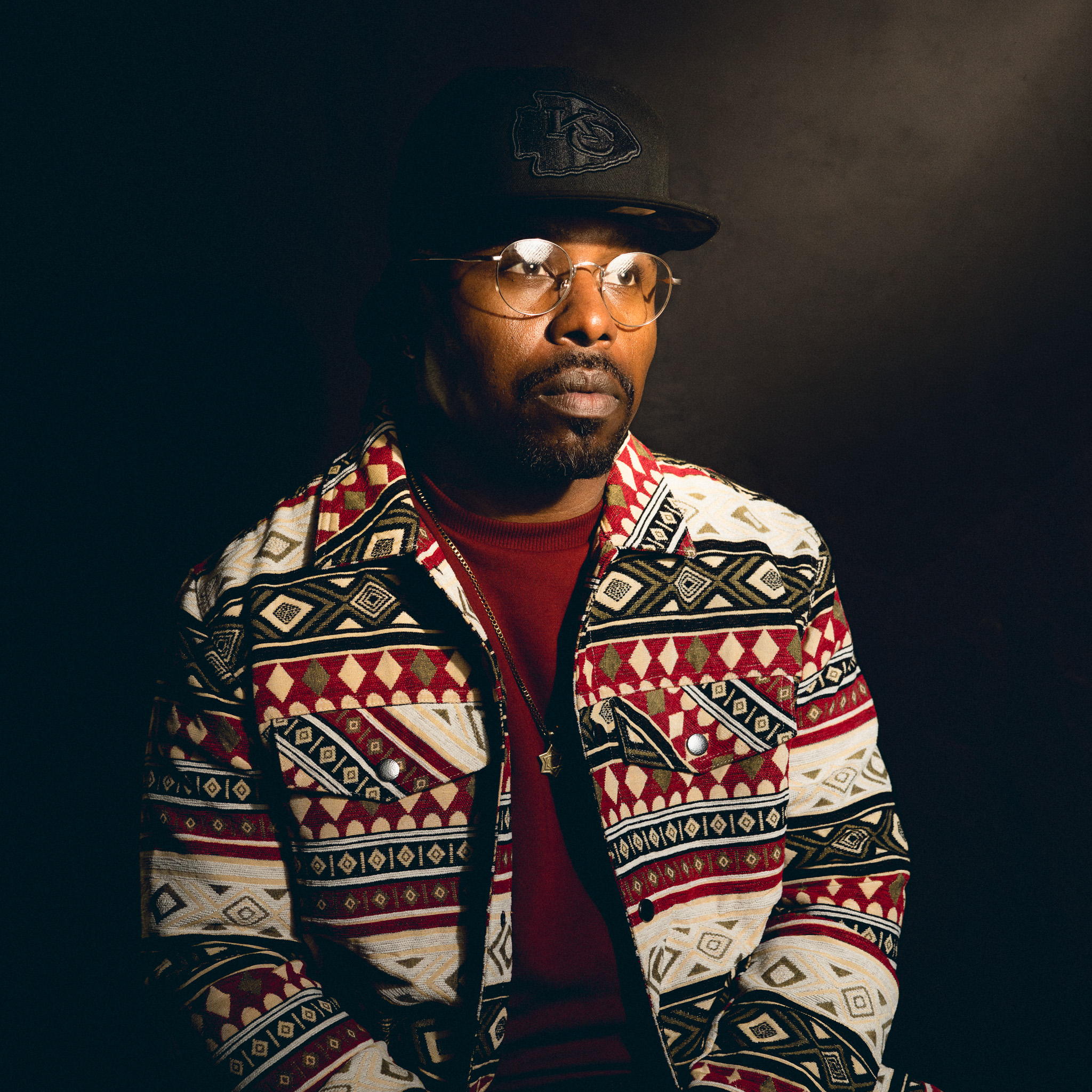
Bones break. Muscles bruise. Flesh bleeds. But no slings and arrows can deter a man who has endured the pain of loneliness. The ache of being without a home. The strain of the black sheep, the outcast, the one they said was never meant to be born. But, in the case of Andre J., there is birth, there is survival, and after all these years, there is life.
1982. The streets of San Bernardino, crack-riddled, war-torn by gang violence, and in it all, was Andre, barely surviving inside his mother’s womb. Upon his birth, Andre was dead for six minutes. If it wasn’t for the quick intervention of the doctors, and the mystical will of a second-year-old, his first breath may have just been his last. It’s a strange way for a life to begin. It’s also the most honest summary of the forty-four years that followed. Andre gets knocked flat onto the mat, and somehow he gets back up—beaten but ready for round two…or maybe even round twenty.
They say that “addiction is a family disease.” Well, in Andre’s case, it’s very true. Because the generational abuse and substance use went back farther than he even knows; His mother’s addiction had been handed down to her by her own father. Her father was an addict. Along with that, he sexually abused her at a very young age. She had four children with a husband who beat her, and when she finally ran, she ran straight into the arms of a wealthy man with luxury cars and a life he kept secret. That man was Andre’s father. Their love affair didn’t last. His mother eventually went back to her husband and had one more child, and Andre grew up as the only one of five kids with a different father. As a boy, he lived with his mother and stepfather’s family—but that’s exactly how everyone made it feel: their family. Not his.
He remembers watching his stepfather beat his mother and feeling anger for the first time. “I didn’t even think I knew what anger was until I saw that. I felt very helpless because I couldn’t help my mother during that time. I didn’t understand why somebody would hurt the only person that I loved like that.” As the drugs took over, the family moved and moved again until his mother couldn’t care for the kids at all. The kids landed at an aunt’s house, and the aunt made sure Andre knew he didn’t belong. She beat him with switches pulled from a willow tree until his skin cracked and tore. At six years old, with his mother gone and his father nowhere to be found, Andre tried to take his own life. His sister found him hanging by the neck in their closet, just in time. She held him and told him, “Baby, you’re going to be okay.” Together, they cried.
The remarkable part is who that little boy still was underneath all of it. He spent his days in the hills behind the house, convinced there was treasure buried out there somewhere. “I loved to love people. I think that’s important because healing a broken person gives them the opportunity for hope when they feel hopeless or worth when they feel worthless. It came from a place within me because I didn’t want to feel like I was feeling.” he says with a smile that cracks when he continues, “I always remember feeling like if I gave somebody enough love and showed them love, then they would love me back the same way.” Eventually, he told a teacher what was happening at home. He was placed in a foster home, and that’s when his father came into his life.
Life with his dad looked like a movie. A house on a hill overlooking the ocean. Gold chains, Mercedes emblems, a Rolls-Royce in the driveway. Andre didn’t know where the money came from, and he wouldn’t learn until after his death that his father was a bank robber. All he knew was that he was the only son among eight daughters, and for the first time, he was loved. He idolized his father—the man who had it all—who took him out of the ghetto. Andre became a straight-A student heading into high school with a brand-new wardrobe and a life full of friends.
Around thirteen, his father’s wife, an alcoholic in her own right, began crossing lines no adult should ever cross with a child. Andre kept quiet for a long time because he was terrified of losing his father. When he finally confided in his mother about the sexual abuse, she drove up that hill with a gun and took her son out of that house. His father kept everything he had ever bought for Andre and gave it away to his sisters or sold it—cutting Andre off completely.
Back with his mother, the depression settled in and stayed. He stole clothes so he could look school. He rapped with his friends under the name Results and took his first hit of weed from a friend who went by the name: “Bazuka Jay Jamaly Scabbarax.” The name has no bearing on the story, but how could I not mention it? The weed was strong enough that, according to Bazuka, Andre was screaming inside his own head loud enough that the whole room could hear it. Weed never stuck. The streets almost did. By senior year, gang life was circling. When someone put a gun in Andre’s hand and told him to kill a man he didn’t believe deserved to die, he knew he needed out. Andre said no, and he picked up the phone. “Look, Dad, if you don’t come get me out of this place, you will never ever hear from me again in life.”
His father came. Things were never the same between them, but Andre found a church family who heard his story and brought him into their home. For four years he gave himself completely to that life, and it gave him the stability he’d never had. He went back to school and, at twenty-one, he became the first person in the program to earn his high school diploma. His mother came to the graduation. None of her other children had made it that far in their education before. But from the pews, something about his new life started to sour. The hypocrisy he eventually saw behind the pulpit drove him out of the church, though he says it never fully drove him away from God.
Then he met a girl, and quickly into their relationship, she got pregnant. Andre had just lost his job, and the fear that his child would grow up the way he had swallowed him whole. He asked her father for his blessing to marry her, and thus began a new chapter of his life. But with this page flip came a cap twist. To ease the panic of his newfound fatherhood, he started to drink…a lot. When selling guns didn’t bring in enough household funds, he called his little brother and a cousin and planned a robbery. “I told myself, ‘I’m removing all my beliefs, all my convictions, all my reasoning to not do this.'”
A double-barreled sawed-off shotgun directly in the face of the woman behind the counter of a check-cashing store. Broad daylight. Andre in disguise, holding the gun, which wasn’t filled with shells because they couldn’t get their hands on any. It was just a prop at that point. A threat, too. Andre’s hands shook. This is not who he was and certainly not who he wanted to be. In his heart, he knew what he was doing was wrong, but when a man steals bread to feed his family, is the man at fault or the system that doomed them to starvation? He was just surviving.
When it was time to flee, the back door they’d planned to escape through opened onto a brick wall. A facade. Like a gun without bullets. Out front, police were already swarming the plaza. But they weren’t there for them—not at first. In an unlucky turn of fate, the bank on the other side of the mini-mall was also being robbed. His brother and cousin were caught almost immediately. Andre crawled on all fours through the bushes, went over a wall, and wedged himself up under a semi-truck parked behind a grocery store. He held on there for forty-five minutes while helicopters circled overhead, until his hands turned purple and the tail of his shirt slipped loose and gave him away.
He had no record. He took the weight so his brother and cousin would serve less time. “I influenced this whole idea. It was me,” he told the court. He was facing fifty-two years and got five, and he doesn’t dress up what he did. “I gave them fear and menace and torment. It was just an act out of desperation.”
Andre managed to stay clean the entire time he was locked up. He joined a firefighting program, became a certified wastewater treatment operator, took college courses by correspondence, and married his children’s mother. He truly made the most of his time behind bars—accomplishing more than many of us do with total freedom.
Unfortunately, when he got out in 2010, none of it seemed to count. The wastewater jobs went to people with perfect test scores and no criminal record. His marriage was straining. So, naturally, he started drinking again. A few months later, his mother called wanting to see him. Andre was hurting and told her he couldn’t make it out. She drove home to Las Vegas that night and died in her sleep. “I just couldn’t breathe. I didn’t want to be in my body. I didn’t want this to be real.” With the financial aid money he had gotten to afford food and books, he paid for her funeral.
A few months after that, his father asked him for forgiveness. Andre was a father of multiple children himself by then, and he understood what it meant not to have all the answers. “I forgive you. I love you. I want you in my life,” he told him. A few days later, his father was gone too.
The years that followed came fast and ugly. Cocaine, then another prison stint, then crystal meth. He got clean long enough to go through a fire academy and become a firefighter, then lost his footing again. After another arrest, he landed on probation in Lancaster with nowhere to go, living in a tent in the desert with a machete, a $150,000 warrant, and a seemingly unkickable habit. One night, he was ready to do another robbery. It was a real, “one last job” situation. He prayed first. He prayed that God would save him from the most heinous parts of himself. The most desperate. The ones that only thought of himself.
Three minutes later, while riding his bike, he was pulled over. The officer made him an offer: give me your real name, and I’ll throw that machete you’re carrying with you in the trash. With his record, the weapon alone could have added 15 years to a sentence that was already going to bury him. Andre gave his name and surrendered to God right there on the side of the road. The officer kept his word. “I gave you my word, didn’t I?” he said as he tossed the machete away. “Fifteen years of my life, he gave me back,” Andre says. That’s his sobriety date. December 19th. He turned his will over to God and his machete over to a cop and hasn’t touched a drug since.
In jail, a man in his unit noticed that Andre never touched the drugs going around, even when they were right next to him. “I like your program,” the man told him, and he gave Andre a name: Beit T’Shuvah. “I think I called a hundred times.” He was visited by Carrie Newman in Alternative Sentencing, and things were looking promising, but before he was accepted, another treatment center, a 30-day program, accepted him. He had a choice: Get out of jail now and go there or stay in jail longer and hold out for the possibility he may get into Beit T’Shuvah.
I’m guessing you know which he chose.
Andre admits that when he walked in the doors of 8831 Venice, he was shaking in his boots—his tattered boots and clothes that he had been wearing when he was arrested in the desert. What he found surprised him the most was the love. Coming into a Jewish treatment center was certainly a culture shock, but he says, “I didn’t feel black. I felt like a person who needed help.” His counselor, Eric Bader, embraced him. Rabbi Iggy, his spiritual counselor, gave him something he’d never been given before. “He looked at me through the eyes of somebody who saw another person for the greatness that he truly is, not for what he has done.”
But how much can a community hold someone in their time of need? Because soon upon his arrival here, tragedy struck Andre’s life. Andre was trying to call his niece, in the hopes of reconnecting with her in his sobriety. He called and called to no answer. Then, he got a call back, but it wasn’t from her. It was a call telling Andre that his niece was killed in a car accident. This community, specifically his friend Josh and other fellow residents, helped hold him up in this crucial time of need. “When I couldn’t carry the weight, he took some of it off of me.” Josh even helped plan the funeral for her. Andre stayed sober because he knew that he had to be there for his family. What they got from a sober Andre, he could not trade for the momentary high. That realization’s stuck with him.
Today, Andre is a development intern, and he’s already dreaming bigger than dollars and cents. “I want to figure out a way where I can generate a massive amount of money to be donated to this place to help somebody just like me.” Because, remember, “Healing a broken person gives them the opportunity for hope when they feel hopeless or worth when they feel worthless.”
On any given day, you’ll find him vacuuming the sanctuary without being asked. “I don’t want anybody on the stage that’s delivering a message looking at this, my home, and it’s dirty,” he says with an unbridled pride. “The fruit of discipline is self-worth.”
For most of his life, Andre survived by doing what we tell every new resident to do: to hold on. Here, in recovery, for the first time, he’s learning what it feels like to be held. “I have never had a community to give me support that this community has given me ever in my entire life.” He’s closing in on the longest stretch of sobriety he has ever had, and he’s clear about who it belongs to. “I didn’t do it by myself. I did it with this community.” That’s the difference between the Andre holding the empty gun and the Andre holding the full heart—family. A family where, when he walked in, the wool of his black sheep mentality was shorn. A family that has helped him find his purpose and find himself. Because he knows one simple fact to be true: He was born dead. He spent the last 44 years surviving. Now, for the first time, Andre gets to live. And that’s because of you.