
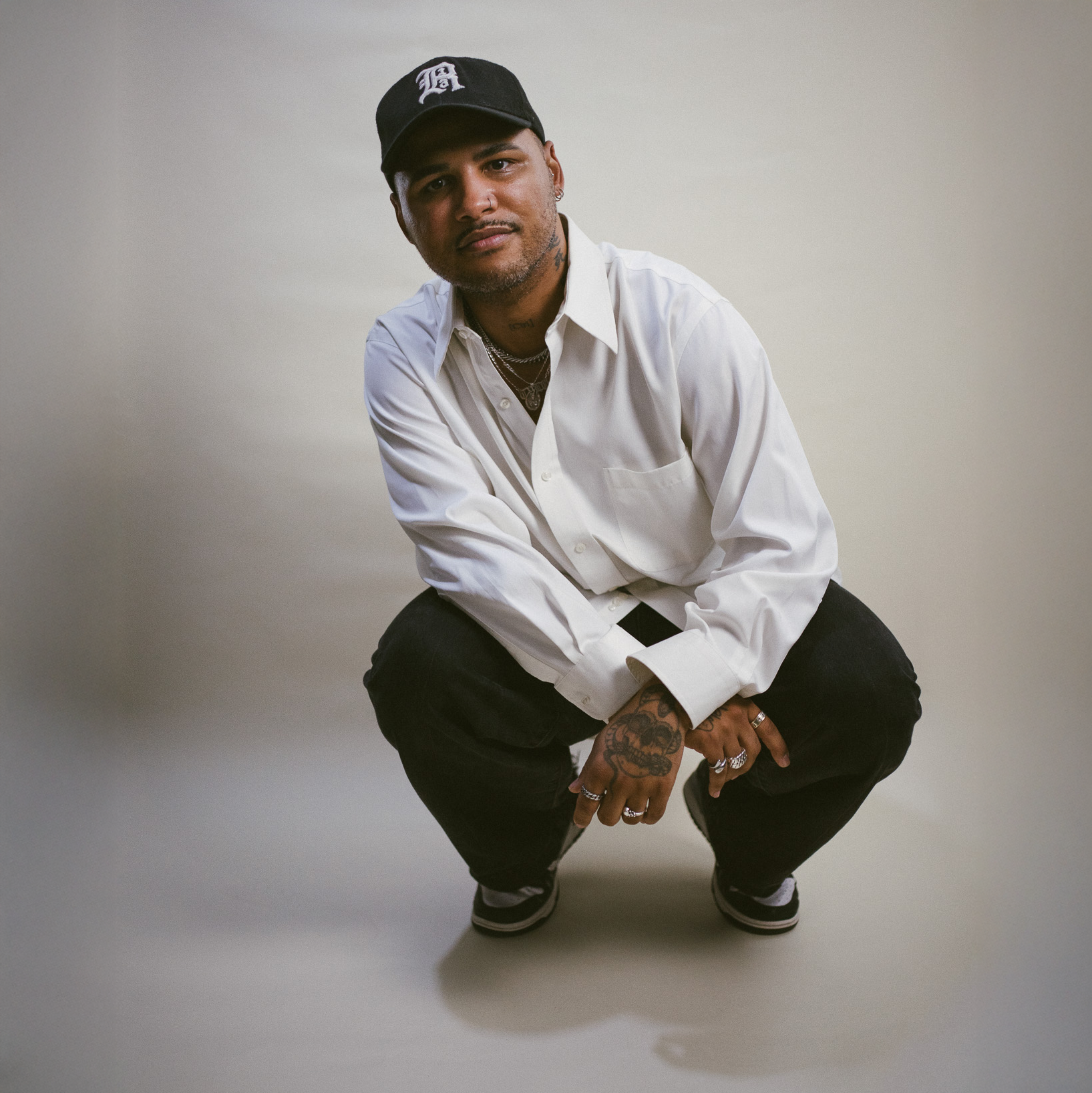
What do you dream of?
From the moment Tylo S. entered this world—seventeen-year-old mother, twenty-year-old father, Portland rain tapping against the glass—the universe seemed to whisper two truths into his tiny, unformed hands: you were born into chaos, and you were born to dream beyond it. His childhood was a kaleidoscope of contradictions: “I grew up with sex, drugs, and gangster rap…and the Spice Girls.” Truly, a juxtaposition of epic proportions. That mixture—chaos and glitter—would shape him for decades.
The house he grew up in thrummed with turbulence—young parents trying to grow up while raising a child, masculinity defined by fear, anger, and a little boy who never quite matched any of it. Incarceration threading through his family like an unwanted inheritance—a burdened birthright he begged to reject. “I grew up around the prison system. My biological father was incarcerated. My stepdad was incarcerated. My uncles have been incarcerated.” As a child, he didn’t question the pattern. “I just thought that was part of the Black experience…that the cops were always coming for you.”
Yet even inside that storm, something luminous pulled at Tylo—something colorful, feminine, funny, unapologetic. “My first love was the Spice Girls. That was my first form of escapism.” He clung to their glittery defiance the way some kids cling to stuffed animals. In a home where emotions ran hot and futures felt uncertain, they represented something radical: freedom and deep down, that’s all he reall,y really wanted. The noise of Tylo’s house was matched only by the noise inside his imagination.
But being born different is one thing; realizing it is another. “I wasn’t your ideal little boy. I liked Barbies. I liked Sex and the City.” Tylo gravitated toward vibrant women, toward sharp humor and softness wrapped in power, knowing from an early age that he was queer. He wasn’t interested in performing boyhood to make anyone comfortable. Even as a child, some part of him insisted on authenticity—even when it cost him the ability to fit in amongst his peers. “I always felt different…I think I always had more in common with adults.”
Still, there was a dream glimmering at the edges of everything—a golden, sun-soaked image of palm trees and possibility. The first seed of it was planted at seven years old, when he visited Los Angeles for the first time. “I remember driving down Sunset, and I was like, ‘I gotta live here. I have to live here.’”
But any good dream is built upon a mountain of pain, and Tylo’s was no different. By his early teens, the collision between who he was and what the world demanded of him became unbearable. He remembers the feeling with chilling clarity. “I felt I had no control and no agency over my life… hurting myself was a way to feel in control.” It’s a devastating moment when a child reaches for harm because no one has taught them gentler tools. And then the drugs came. Not slowly. Not cautiously. Like a fuse catching fire.
Sixteen was the year everything exploded. “Sweet sixteen,” he says, with a dark half-grin. Ecstasy binges, nights that blurred into mornings, the first line of cocaine—“I totally understand why people get addicted to this.” Some people learn that the stove is hot by being warned. Others learn by touching it. Tylo was the child who looked at the flame and said, I want to know what burning feels like.
After a two-day ecstasy roll and a viscous fight, Tylo left home. He walked out with a teenager’s stubborn pride and a child’s quiet heartbreak. “I packed my bags and never looked back.” What followed were years of drifting—friends’ couches, mall jobs, borrowed time, borrowed space, borrowed hope. “Where am I going to sleep tonight?” isn’t a question any sixteen-year-old should ask, but it was his constant refrain.
And through all the survival, there was still the dream—the whisper of Hollywood, the imagined life where he could finally stop apologizing for who he was.
But aspirations don’t protect you from loss, and at twenty, Tylo’s life was cracked open in a way that permanently rearranged his heart. His stepbrother, Terry—handsome, loved, athletic, the one who fit in—took his own life at only seventeen years old. “It changed my family dynamic forever.” But it didn’t just change his family—it changed Tylo. In many ways, this sent Tylo off the edge. He felt as though he had nothing to lose. “I used to say the worst thing has already happened…I’ve already gotten the worst phone call.” Terry’s death sank into him like a stone—heavy, cold, impossible to ignore. Yet in the strange mathematics of grief and fate, loss sometimes becomes the soil where something unexpected grows.
Five years later, that unexpected miracle was his nephew, Zaydn. “The biggest blessing that’s ever come into my life.” His sister was seventeen when she found out she was already twenty weeks pregnant. And in the middle of fear and shock and generational déjà vu, this tiny baby arrived—a boy with eyes that mirrored both past heartbreak and future hope. A cyle-breaker. “I see so much of my brother in my nephew. I could very easily see where Terry’s death directly influenced my nephew being born… flawed and fucked up, but still divine.”
And with Zaydn came something Tylo had always longed for: an opportunity for change. “Whatever he wants to do, we completely support that.” Loving Zaydn gave Tylo access to a childhood he never had—the one where your dreams are met with encouragement, not ridicule. “It heals that part of me,” he says softly. “It makes me feel,” he takes a soft beat, “…the cycle doesn’t have to continue.”
But love alone couldn’t pull him from addiction. Cocaine still whispered. Alcohol still numbed. Chaos still beckoned. And yet, the dream remained.
At twenty-eight, he finally listened to it. He moved to Los Angeles, “like Madonna with 200 bucks and a dream.” Hollywood didn’t just open its doors to Tylo—it blew down walls a paved the roads with red carpets. As a stylist, he found himself slipping into a world he’d yearned for before he could even remember. Quickly, Tylo found himself dressing celebrities of every letter type. He was standing in penthouses that overlooked the city, rifling through racks of designer gowns and leather jackets under the glow of floor-to-ceiling windows. Assistants scurried around him, steaming couture while publicists whispered schedules into cell phones. He’d walk into a client’s house and see Grammys arranged like knick-knacks, scripts scattered across marble countertops, dogs with Instagram followings bigger than most cities. And in the middle of it all was Tylo—confident, intuitive, with an eye sharp enough to cut through the noise. He could take a model, an influencer, a rockstar’s daughter, a rising actor, and dress them into the most magnetic version of themselves. He wasn’t just picking clothes; he was crafting personas. He was part artist, part therapist, part alchemist.
But soon, the glitter became grittier, and the life of a celebrity stylist started to wear on him. Styling meant after-parties in neon-lit rooms where actors passed around champagne like water and singers invited him into circles of people whose names lit up marquees. It meant 2 a.m. fittings with clients who were too high to stand still, brushing powdered residue off mirrored vanities, and watching PR teams scramble to hide what everyone already knew. If he said yes to the right person, he’d end up in VIP booths with celebrities who didn’t have to wait in lines, who whispered invitations to private after-hours spots where the real stories happened. The industry rewarded excess: free drinks for connections, designer samples if you “knew the right girl,” coke and pills casually offered as if it were breath mints. And because he wanted to belong—to be seen, to be admired, to never again feel like the kid who didn’t fit anywhere—he kept up. The styling world fed his creative fire, but it also fueled his addiction. He could make a celebrity look flawless on camera, but he couldn’t costume-change his own unraveling, couldn’t hem the edges of the emptiness growing inside him. Before his eyes, his life went from glow up to blow up.
So, he was faced with a choice: get help or go home in defeat. Tylo chose help and decided to get sober. He reached out to a friend he had who was going to 12-Step meetings and started to go with them. Tylo found himself gathering bits of time here and stints of time there, but ultimately, he couldn’t sustain it. The life he was living was too much. The coke, the drinks—the occasional weekend meth use that would bring him to his knees—all became too much. More help was needed…and he knew it.
So, Tylo called a place he barely understood, guided only by the memory of his mother getting treatment the year before. He had no idea that the phone call would lead him somewhere that felt like fate: Beit T’Shuvah.
Here, in a community built on honesty, heartbreak, and hope, he found something he had spent his whole life craving: a place where every version of him was allowed to live. The flamboyant kid. The angsty teenager. The grieving brother. The exhausted addict. The dreamer. The seeker. The loud laughs and the quiet fears. All welcome. All seen. All loved.
Inside these walls, Tylo stopped running. He started listening. He started healing. People noticed his heart immediately. One thing became abundantly clear to Tylo: he showed up fully…and he did. He gave himself over to the work with a kind of reverent determination only someone who wants this more than anything can give. He listened. He learned. He questioned. He pushed himself toward a life bigger than the one addiction had carved out for him. For the first time, he allowed himself to imagine a future that didn’t hinge on survival, but on becoming. The shimmering, unkillable belief—planted at birth—that his life could be something extraordinary.
Beit T’Shuvah has boosted my confidence so much. I always felt like I was in that ‘fake it till you make it’ mentality. I came off as very confident, but I didn’t necessarily believe it. Beit T’Shuvah, in 80 days of being here, has made me so confident in my abilities. It’s given me back hope. It’s given me back faith. It’s given me back wonder. I feel like anything is possible.
Today, Tylo is discovering a truth that eluded him for years: that dreams don’t just belong to children, that wanting more for yourself is a radical act, and that aspiration is not a fantasy—it is a compass. He is building a life that his younger self would have screamed with joy to see.
A life where pain can be spoken aloud. Where identity is celebrated. Where love is reciprocal. Where healing is possible. Where dreams are allowed to grow roots. Where he helps others as a career—to save lives. That doubtful nature of his finally has answers. “I always needed to know the why.” And maybe, for the first time, the why is simple:
Because he deserves joy.
Because he deserves peace.
Because he deserves recovery.
Tylo, the man who has always been unapologetically himself, has finally become less concerned with seeing his name in lights and more concerned with seeing it written in the book of life. He is no longer the boy who begged the world for a better story—he is the man who wrote it. And after chasing the highs of Hollywood, he’s now living the one fantasy he never thought he’d earn: a life that is sober, steady, joyful, and astonishingly his—a life beyond his wildest dreams.