
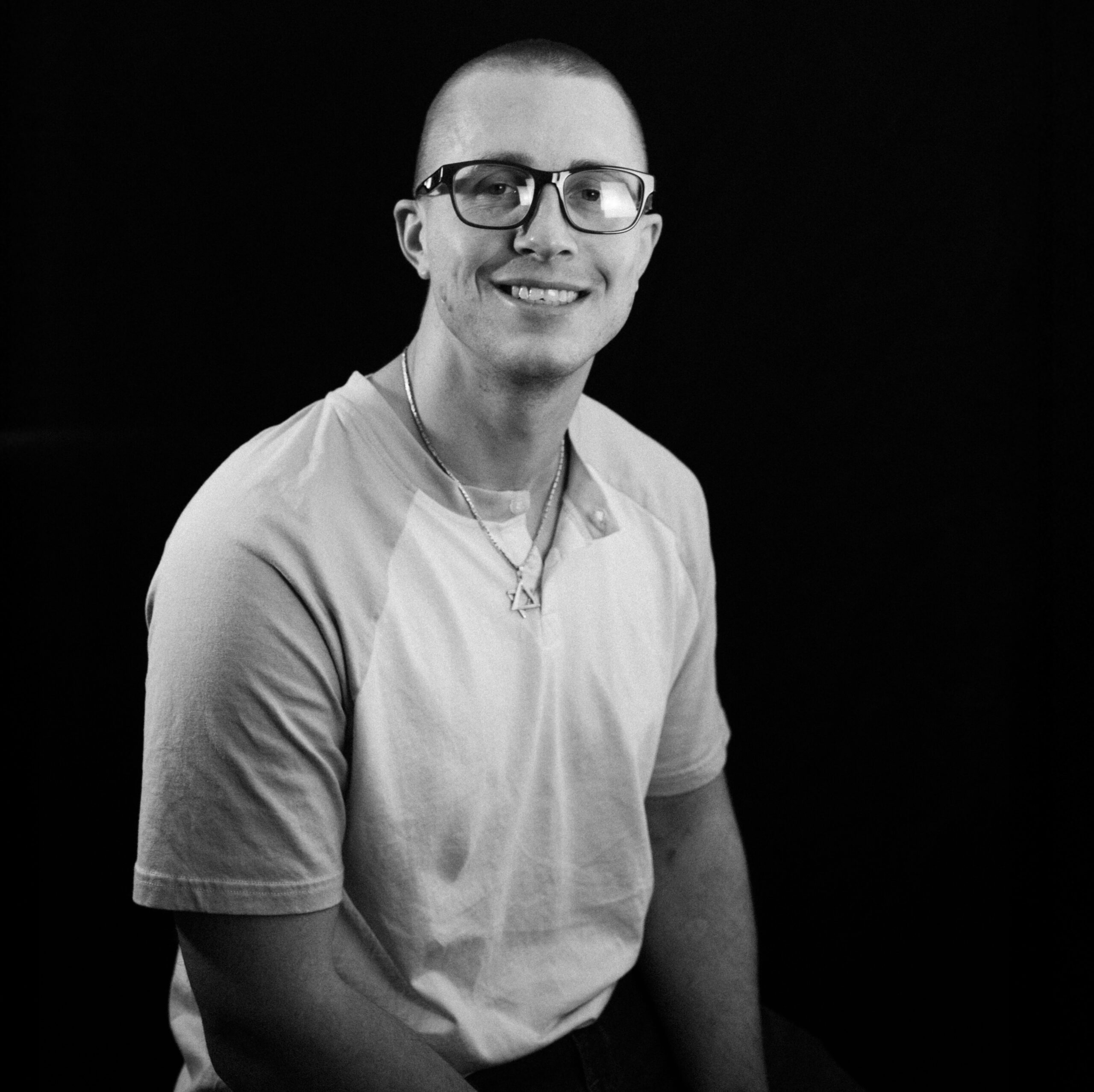
Survival without connection is just isolation with a heartbeat. Resilience means nothing if your life isn’t your own. Every Friday, we tell the new residents to “Hold on!” but maybe, just maybe, we should be more specific. Because, for someone like Kyle P., what you hold onto can be the difference between life and death.
Kyle grew up in a town small enough that nothing ever got lost. Everyone knew everyone else’s business, and missing socks were always found. Four square miles. Two hundred kids in his graduating class. Bikes left in driveways. Doors unlocked. “I feel like I had a pretty idealistic childhood.” His childhood was all sticks, stones, balls, and bikes. There were no iPhones, iPads, and Xboxes to rot his brain. He’d figure out ways to try to do that later. A boyhood shaped by routine and familiarity, by knowing where you belonged—even if, deep down, Kyle sometimes wasn’t sure he did.
He was adopted into a middle-class family in Ohio, raised by parents who loved him and made sure he always knew it. Still, there was a quiet sense of difference that followed him early on. A low hum in the background. “I feel like I was kind of always… a little bit different than everybody growing up.” Kyle was sensitive, observant, funny in a way that didn’t need applause. “I’ve always kind of laughed at my own jokes more than anybody else.”
Judaism was part of the fabric of his upbringing. He had a bar mitzvah, stood on the bimah, spoke the words. Blonde hair, blue eyes, adopted into the tribe—never fully certain where he fit, but absorbing the values anyway. Family mattered. Showing up mattered. When he was young, his parents adopted his younger brother from Russia. His brother had many health issues that had to quickly be attended to—leaving Kyle feeling overlooked, but knowing that his needs came second, or third, or fourth…or maybe they didn’t matter at all. He wasn’t sure. All he knew was that he was going to be there for his family and that his family loved him. His mom, a registered nurse for forty years, lived a life of service. His dad brought movement and energy into the house—cars, racing, Ohio State football, loud dinners, a big presence. “He was the glue that held our family together.”
Kyle was 14.
Freshman year of high school.
That’s when his father took his own life.
The glue that had bound his family—his life—was gone in an instant, and Kyle was left picking up the shattered pieces. This is a kind of loss that quietly rearranges everything. He left Kyle a note. “He wrote a note to me saying I had to be there now for my mom and my little brother. So I feel like I had to kind of grow up really fast, and I didn’t know what the fuck I was doing either.”
Grief didn’t arrive all at once. It settled in layers. Kyle became the strong one by default. “I was the shoulder for her to cry on. That kind of was the start of me burying a lot of my emotions, too.” He learned how to survive by being needed—by carrying weight quietly and not asking where to put it down.
High school continued. Sports faded out. Parties moved in. Weed. Alcohol. Self-destruction. “It definitely was a social lubricant. It made me take my guard down…feel more comfortable around other people.” For the first time since his dad died, the noise inside him softened. He found connection. Identity. Relief. He graduated, skating by academically, and went off to college to study psychology—drawn to understanding how people think, even as he struggled to understand himself.
In his early twenties, after college just became a blur of drinking and ditching, Kyle went west. California felt like distance and permission. He worked on a weed farm in the Emerald Triangle, surrounded by forests and isolation. When he came back to Ohio, pills came with him. He had never had that “aha this feels so damn good” drug addict moment we always hear about…that is, until he started doing the opiate known as “Roxy 30s”. Those damn dirty 30s.
From there, the slope steepened fast. Pills turned into heroin and crack. “I never had an aversion to it. I’ve always been kind of a thrill seeker.” The ritual took over—the cooking, the needle, the rush. “That rush was unlike anything else.” Using stopped being a choice and became a necessity.
Loss followed closely behind when his best friend died in a car accident. Another overdosed after they’d gone through a wilderness program together. “Losing people has always been kind of traumatic for me,” Kyle says sorrowfully. “I think being adopted, losing my dad, losing my best friend… has made me really scared of getting close to people.” He learned that closeness came with risk—and that disappearing sometimes felt safer.
To afford his habits, Kyle sold everything. Family heirlooms. His dad’s Breitling watch. A baseball card collection, he didn’t yet understand the price of selling. No pawn shop could put a price on sentimental value, but that didn’t get in the way of the sale. “At the time, I didn’t give a fuck. I just sold everything to feed my addiction.” What couldn’t be sold was abandoned. Relationships. Stability. Any version of a future that required staying present.
He tried to stop. Treatment in Ohio. A geographic move west. Another attempt to reset. But addiction followed him. When his mom and Stepfather, a renowned Rabbi, moved to San Francisco, he joined them. Unfortunately, here he spent more time in the Tenderloin doing speedballs before work. Then came the Salvation Army—nine months of structure and discipline that, for a while, held him together.
Eventually, Kyle ran out of places to land. That is, until he found Beit T’Shuvah. This was in 2016—his first stay. Never a good phrase to hear. After a handful of months and a frowned upon relationship, he was asked to leave. “I got kicked out and lost my community.” He admits that he distanced himself, but the feelings were all the same. Back to isolation. Back to survival. And this time, the stakes were never higher.
“I’ve been on the street the past almost six years.” Los Angeles taught him endurance in its rawest form. Petty theft. Jail. Needles. Cold nights. Days that blurred together. Nights spent alert and exhausted. “My rock bottom is not going to be doing drugs,” he remembers thinking. “It’s going to be me losing my fucking mind out here.”
Surrender came quietly when he passed out at a bus stop in Glendale—tucked into in a blanket of used syringes. A pedestrian called 911 for a welfare check, and soon Kyle awoke to a cop standing over him. “I’m fucking done, he cried, “I’m so fucking exhausted and tired and beat down.” Jail followed. And then, for reasons he still doesn’t fully explain, another chance.
Kyle came back to Beit T’Shuvah. Always a good phrase to hear.
This time, it felt different—not dramatic, just real. He kept his distance at first. Ate meals alone. Stayed in his room. “There was a time where I wouldn’t even want to go downstairs to fill my ramen up with hot water.” That animalistic instinct to isolate took hold once more. But eventually, slowly, trust reared its head. Therapy helped. Structure helped. Being surrounded by people who understood helped.
Today, Kyle is a Program Facilitator. “I really enjoy helping people,” he says with a newfound pride. “Seeing their eyes light up when they realize they’re not alone.” He remarks that he isn’t too much farther ahead than the clients—just far enough to turn around and reach back. Kyle’s instinct to help others—to save lives—is clearly reminiscent of his mother. As a nurse, she has saved countless lives, and today, he follows in those footsteps. He didn’t get to see his family when he was on the streets, but “I think for a while my mom became my higher power.”
Since coming to Beit T’Shuvah, his relationship with his family has been rebuilt. “It’s really night and day.” After years of separation, trust has returned. His mom and step-dad joined the Beit T’Shuvah congregation—watching every Shabbat livestream. “They feel so strongly connected to this place.”
Kyle’s connection with his father has grown as well. Cars, racing, Ohio State football—he still loves them all and thinks about him when he enjoys them. “Depression is real. I’m not judgmental of that anymore. Depression is very serious.” What remains now is compassion, perspective, and a deeper understanding of what it means to stay. And if you’ve seen it—which many of you have—you know that when Kyle smiles, it lights up a room. Just like his father.
Kyle’s story isn’t about redemption. It’s about endurance. About how long someone can disappear and still find their way back. About choosing, finally, to stop running.
After years of leaving—homes, relationships, himself—Kyle is here. Still showing up. Still helping. Still learning how to stay. His days of isolation have turned into warm embraces and shoulders wet from the tears of those he has helped. His once vacant existence has now been occupied by love—his soul is full. His life large. Today, with his head held high, he can confidently say that he isn’t surviving—he’s living.