
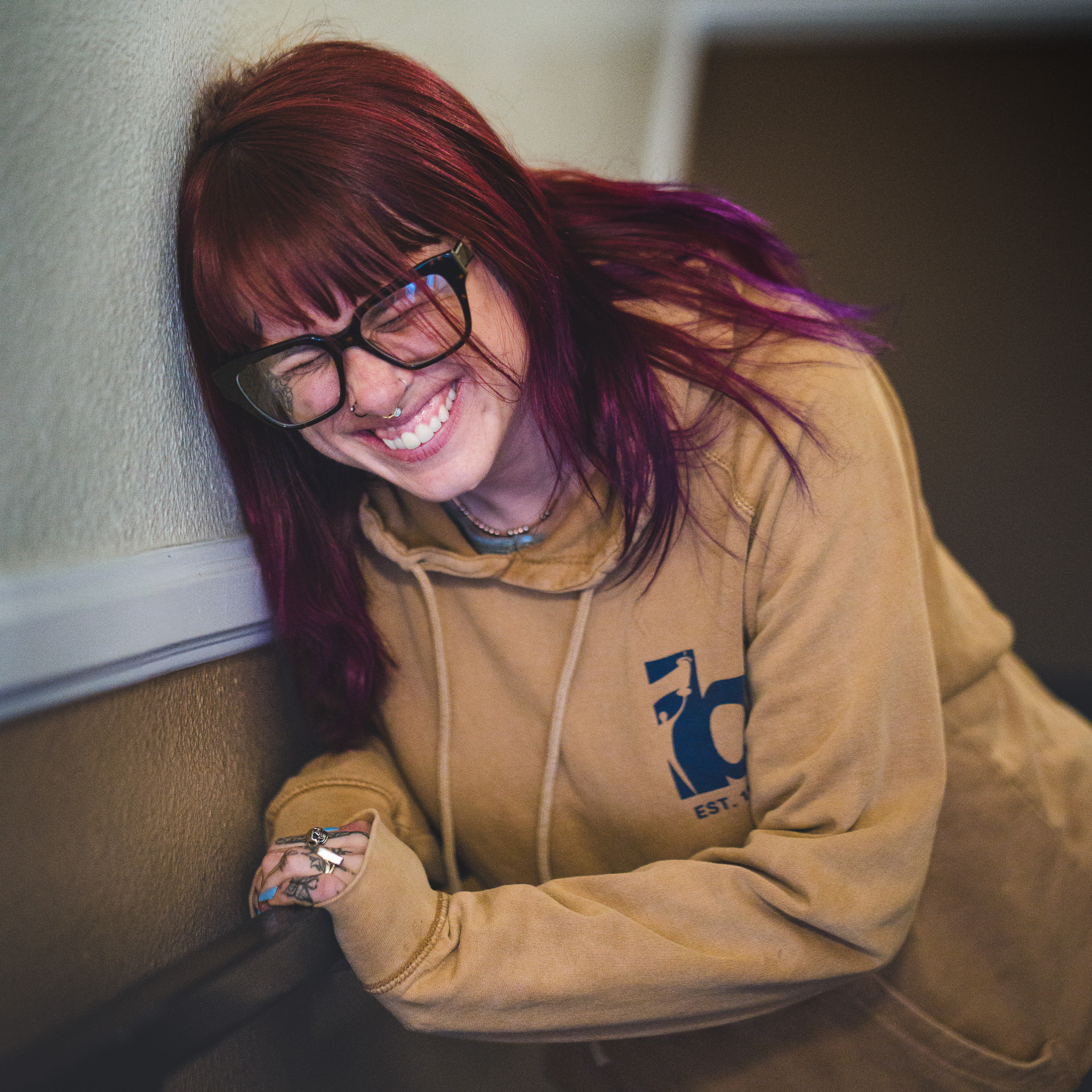
Drugs often find their way into our lives—before we have a chance to discover who we really are. Then, labelled a problem, an addict, from a young age. That, in turn, is who and what we become—the drugs, the addiction, and everything that comes along with the lifestyle. The adolescent and evolving identity forms around the notion that we possess a problem that needs to be solved. That we are the issue. Will anyone be able to fix us?
For Julia T., that normalcy every kid strives for never quite existed. From the beginning, Julia’s life has been shaped by movement—geographical, emotional, and institutional. Adopted and raised in Atlanta, she remembers a city that felt materialistic and rigid, a place where she never quite fit in. By 15, Julia had already entered her first treatment program—labeled “behavioral modification,” it wasn’t focused on substance use, but on correcting who she was and how she showed up in the world.
Later on, she’d attribute her real introduction to hard drugs to being forced into rehab prematurely. “I went to treatment at fifteen, and then when I actually started using later, it was like I already knew the role I was supposed to play.”
College came next. Julia enrolled at Birmingham-Southern University, majoring in psychology and minoring in theater, but the structure didn’t hold, and she dropped out after a year. “The president of the school knew me as ‘Party Girl’. My dad used to say I majored in ATO and minored in beer pong.”
What followed was the beginning of the slippery descent into true and rugged addiction. First, it was couch surfing at friends’ places to avoid having to be sober at her parents’ home. Next, the development of a taste for cocaine, shortly after an arrest for possession of marijuana, “That’s when my parents said, ‘homeless or rehab.’ So I went to rehab.”
Substance use escalated quickly after her first adult rehab experience at 19. “I met a guy at the rehab, left with him, and within two days had a needle in my arm. I didn’t even know you could shoot drugs. I thought crack was the worst drug you could do.”
Eventually, after that relationship ran its course (all the way to Florida and from heroin to Oxy’s), her father intervened, and Julia was sent to Oregon for long-term treatment, where she would meet Sarah, her friend who would later introduce her to Beit T’Shuvah. What she found in Oregon was different from anything she’d experienced before. The program was small, focused, and intense. “It felt like a home, we had our own rooms. We decorated them. It wasn’t clinical.” The woman who ran the program took in young women with complex histories—those others had given up on—and held them to a high standard rooted in honesty rather than punishment.
Julia stayed seven years. During that time, she built a life. She went to meetings daily, sponsored others, held jobs, and maintained sobriety for long stretches. “My life was beautiful. It was the hardest seven years of my life, but it was worth it.” She also fell in love, and when that relationship ended, the foundation she had built began to crack.
Relapse followed—first softly, then violently. Over the next several years, Julia’s life became marked by instability and trauma: abusive relationships, sexual violence, physical harm, and repeated attempts to escape circumstances that only seemed to tighten around her. Each time she tried to reset—moving states, entering new programs, starting over—the pain followed. At one point, her boyfriend and his cousin held her prisoner in a trailer for six months, only allowing her to leave to shower or clean the house.
Then, Julia’s breaking point came when she lost her father. They had spoken regularly, even when distant, and shortly before his death, Julia was able to spend ten minutes alone with him on the phone. “Then he was gone.” The grief was immediate and destabilizing. “I went home for the funeral, came back to [my boyfriend], and then we got into an argument, and he was on top of me, wailing on me, and I had this image of my dad crying above me. And I called my coworker and was like, this man’s beating me. Get me the fuck out of here now.”
Work saved her life—temporarily. Julia’s job relocated her to Hawaii to keep her safe from her abuser. Coincidentally, Hawaii had once been her dream destination, “I always wanted to live there, and I got to for five months…I was working with troubled teenage girls who were addicts. It was like a behavioral mod. I had to restrain the kids. They wore uniforms, it was almost like a military school.” Within weeks, she was using again. She made rules for herself around drug use, broke them one by one, and finally called her employer and asked for help.
A short-term program was offered. Julia knew it wouldn’t be enough. And that’s when she did something differently. With the help of Sarah, she called Beit T’Shuvah. Sarah. “I got myself here…I made the calls. No one picked this for me. I knew where I wanted to go, and I did it.”
From the start, something felt different. “I wanted to be here, I wasn’t scared. I was excited.” Julia quickly found community, leaned on people she trusted, and began doing something she hadn’t done before: staying present through discomfort instead of running from it.
At BTS, Julia also encountered something she had rarely experienced in treatment before: space to be herself without being corrected. She does not identify as religious, and she does not pretend to be. “I’m a witch,” she says plainly. Julia practices Wicca, an Earth-based spiritual path rooted in a connection to nature. Tarot, crystals, and astrology are all part of how she understands the world. Rather than being dismissed for her beliefs, she feels respected at Beit T’Shuvah, “No one’s trying to change me here, and that’s a relief.”
Rather than being dismissed or treated as something that needed to be redirected, Julia found her spirituality respected at BTS. “No one here is trying to change me, they’re curious. They ask questions. They let me be me.” That acceptance matters deeply for someone whose life has so often been shaped by institutions focused on correction rather than understanding.
Today, Julia is doing the slow work of redefining who she is outside of crisis and institution. She’s learning how to sit with anger without letting it control her. How to disengage from drama. How to protect the depth of love she gives so freely. “I’ve been taught my whole life that I’m the problem, I’m just now unlearning that.” This is an important and powerful statement, and proves the process of discovering who she truly is has begun.
Looking ahead, Julia knows what she wants: nature, land, and horses. She dreams of opening an outpatient equine therapy program for addicts, alcoholics, and people with disabilities. “I don’t want to disappear anymore. I want to build something. I want to get better at speaking up for myself and saying what I feel is right or wrong, being honest, and doing what I want to do. Being able to say things—the hard truth—even if it makes me uncomfortable. I want to get better at confrontation. ”
For the first time, Julia isn’t being controlled, corrected, or contained. She’s choosing the life that she wants for herself, under her own directives. With the support of her close friends, and with the guidance of a treatment team that truly wants the best for her. It’s that initiative, that autonomy, and that support that is providing her with the tools to succeed—the knowledge that she isn’t broken and has never needed to be fixed.