
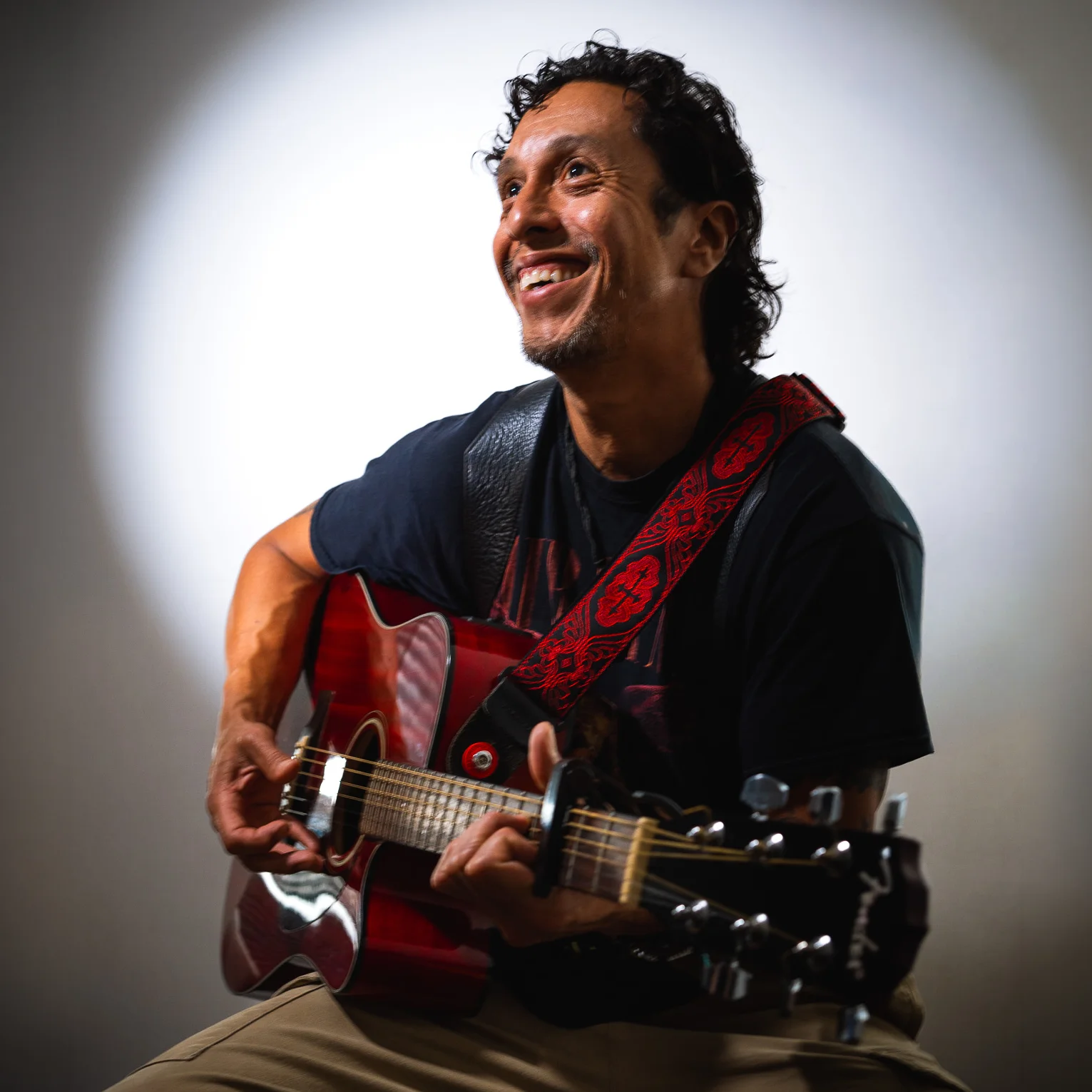
A lotus flower has a long journey to embark on from a seedling. It starts in the mud, and eventually it breaks the surface of the water in a beautiful display of growth. Joel G.’s story reminds me of this process. I see him emerging at the water’s surface of his greatest life. Joel has endured a long road, and it’s clear he’s ready to arrive at the destination of a grounded life. The foundation is there—established 19 years ago at Beit T’Shuvah. He has been through a tremendous struggle from youth, thrust into rehab at 13 years of age. Growing up in the streets of Chicago in the 80s was a rough time, and you can feel the weight of Joel’s life’s battle through the stories he doesn’t share. He’s a father of two young boys and is ready to step into the role with a steadfast grace and passion. Sometimes it takes a moment to find ourselves, but once we do, there’s nothing standing in the way of becoming the person who we are truly meant to be.
Violence, gangs, and instability were simply part of the landscape. His parents both struggled with addiction, and the chaos that surrounded their lives shaped much of Joel’s early years. When he was eleven, he went to live with his uncle, and not long after, his mother passed away from AIDS due to drug use.
Even with family stepping in, stability was hard to find. Joel entered foster care through Mercy Home for Boys and Girls, living in a residential boys’ home while attending school at St. Gregory’s. Looking back, he recognizes how early the patterns of addiction were already forming in his life. His uncle tried to intervene, sending him to rehab when Joel was only 13 years old after noticing he had already begun drinking and smoking. The program didn’t stick, but it marked the beginning of a long and complicated relationship with recovery.
As Joel moved into adulthood, he followed his uncle out to California—hoping for a fresh start. Instead, the instability followed him. Jobs came and went, relationships were turbulent, and addiction continued to deepen its hold. A newfound meth addiction ended him up homeless and on the streets of Los Angeles doing whatever he could to survive.
Eventually, his life caught up with him in the form of an arrest, charges that stemmed from a chaotic and toxic relationship. “It was a combination of drug possession and battery, then they dropped those charges and picked me up on another misdemeanor—corporal punishment.” The relationship itself was fueled by addiction and volatility. “We were both in this kind of circus of a relationship—drugs, sex, violence.”
After violating a restraining order connected to the case, the court system had seen enough. Joel was facing a prison sentence, and the weight of that reality finally hit him. “They basically told me, ‘If you violate this again, you’re looking at three to five.’” Desperate for another option, he pleaded with the court.
Instead of prison, Joel was offered a chance at treatment. It took seven months for the courts to find placement while he sat in jail waiting to learn his fate. In 2007, when Carrie Newman came to his rescue, that placement became Beit T’Shuvah. For Joel, that first experience planted a seed that would take years to fully root. “The first time I came through here, I was a kid. I didn’t have any connection with anything. The most important thing I learned from BTS was how important community and spirituality are in recovery.” Joel immersed himself in the life of the community, performing in Freedom Song, singing in the choir, and building relationships that offered him a sense of belonging he had rarely experienced before.
After leaving BTS, Joel was only able to sustain his sobriety for six months before he relapsed. “I left here with a girl who was a heroin addict, and I became a heroin addict with her.” That relationship eventually led to a devastating car accident in 2011, one that remains one of the most surreal moments of Joel’s life. Joel walked away from the wreck without a single injury. His partner did not. “I came out of the wreck without a scratch, and they had to pull her out of the car with the jaws of life.” She was rushed to the hospital, where doctors initially believed she had died. “They pronounced her dead on the table, then she just came back.” The accident left her with severe injuries, and Joel shaken to his core. For a time, it scared him straight. He stayed sober for roughly two years before addiction eventually crept back in.
Joel would find sobriety again and maintain it for seven years, a stretch of time that included marriage to a dancer who would later leave him and move back to England without him. The next relationship with the mother of his sons would be the beginning of his biggest test.
Fatherhood began to shift something inside of him. “I couldn’t say I really got this thing until my son was born,” he reflects. But life remained complicated, and the relationship with the mother of his children eventually fell apart. When she became pregnant with their second child, a restraining order forced Joel to leave the home. He traveled north for work during that time and missed a critical custody hearing. “I showed up late to my court date, and that was enough for them to push through the restraining order.”
That moment marked the beginning of several difficult years in which Joel drifted between jobs and cities, trying to rebuild his life while struggling to reconnect with his children. “For the past five years, it’s basically been me trying to convince the mother of my kids that I’m not a danger to her or my son’s”.
Eventually, the weight of addiction, instability, and distance from his family became too much to carry alone. Even during that period, Joel knew he needed help and had already been in communication with BTS about returning. Lysa Harrison had spoken with him, and the door was open, but Joel had not yet taken the step to come back.
His mental state deteriorated significantly. At one point, he locked himself inside a trailer for nearly a month with copious amounts of ketamine, daily alcohol consumption, and isolating himself, losing touch with reality. By the end of that month, alone in the trailer, he reached a point of desperation and could not spend another day alone.
After 7 days in detox, he’arrived at BTS with a very different perspective than the young man who first walked through those doors nearly two decades earlier. “The most important thing for me this time is understanding that I cannot live my highest purpose unless I’m completely sober. There’s no going back for me. There’s no thought like, ‘maybe one drink.’ My thoughts of any successful using or drinking have been erased.”
What Joel realized was that he needed something deeper than simply managing addiction. “AA helped treat my alcoholism,” he explains, “but what I needed was a deeper spiritual experience—community, spirituality, everything that Beit T’Shuvah brings together.”
Since returning, Joel has thrown himself back into the rhythm of community life. Training for the LA Marathon, interning in the kitchen, and now working construction with fellow community member Michael Kaminer, director of Freedom Song—the play that introduced them to each other 19 years ago.
Today, Joel carries a different sense of clarity about who he wants to be and what he wants his life to look like moving forward. “This time around, I’m a completely different person. I have much more to live for, and I want to live my best life.” More than anything, the future he imagines centers around his children and the opportunity to be present in their lives. “The thing I’m most looking forward to is being more a part of my sons’ lives.”
For Joel, the seed of a better life was planted nineteen years ago and has just finally begun to break the surface. He’s out of the mud, and he’s breaking through to the surface. The road has been long and often painful, but growth rarely happens without struggle. The kind of struggle Joel has endured makes him the strong, intentional, kind, and wise person that he is today. Like the lotus pushing up from the mud toward the light, Joel stands at a moment in his life where everything he has persevered through is beginning to transform into something new—a life grounded in sobriety, responsibility, and the chance to be the father and man he knows he was always meant to become.