
Where are you reading this right now? Read it somewhere different. Break out of routine. Do something every day that makes you uncomfortable—that allows you space to grow. Comfort zones can be hazard zones when left unexamined. Take Gabe K., for instance. For him, isolation was comfort. For him, seclusion was success. For him, life felt small. That is, until he turned small steps into massive leaps towards a future he never thought possible.
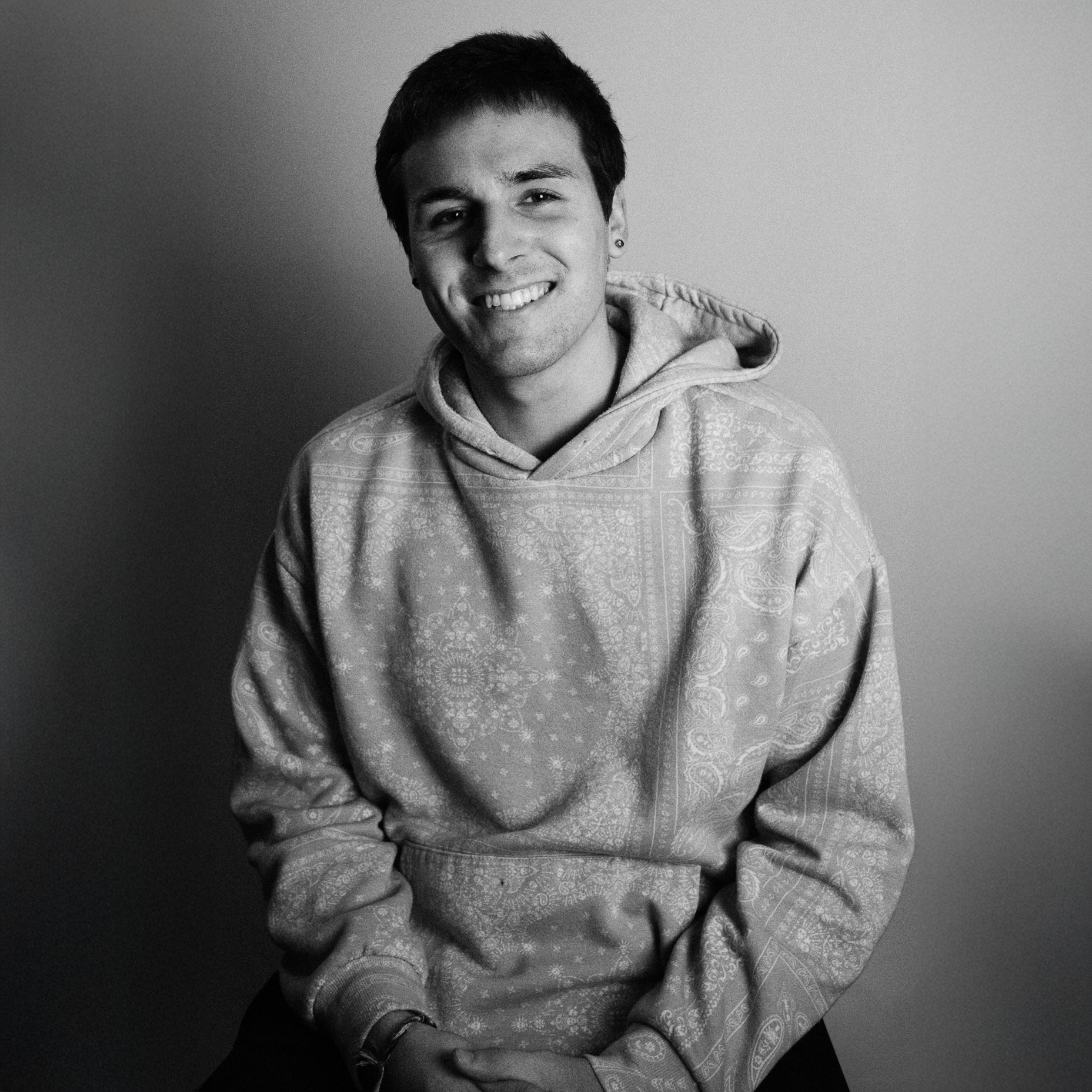
One look at Gabe and you would assume that his smile is all the light the world needs—you’d be right. He’s quiet, reserved, but when he cracks that grin, you can’t help but join him. You’d also probably assume that he has lived an easy-peasy no-problem existence—that’d be where you’re wrong.
Gabe was born in Kansas City, Missouri, adopted at birth, and flown west into a family whose love for him knew no borders. He grew up in Pasadena, surrounded by neighborhood kids, baseball fields, and the kind of childhood that doesn’t raise any immediate red flags. No singular lightning bolt moment, no obvious catastrophe he could point to later on and say, That’s where it all went wrong. Instead, there was something quieter—the gravitational pull of an internal tidepool.
Gabe learned early how to take up just enough space to exist without demanding attention. When he felt comfortable—truly comfortable—he could be goofy, playful, and magnetic. But those moments were selective. More often, he stayed to himself. Isolation felt safer than risk.
At twelve years old, that comfort zone expanded outward—but not in a way that sparks positive growth. Weed entered his life, and with it, something that felt like belonging. Older kids noticed him. Welcomed him in. He was funny. He was available. He had something people wanted. “Once I started smoking weed, it was game over.” It wasn’t rebellion—it was access. Weed became a bridge to connection that didn’t require vulnerability, only supply. They weren’t real friends. They were weed friends. But belonging built on substances is fragile. It asks for more and more while quietly hollowing everything else out. Today, he looks at those older friends in a new light. You may assume that a twelve-year-old hanging out with older friends means fourteen or fifteen-year-olds. No. These “kids” were in their late teens and early twenties…hanging out with a twelve-year-old. Real cool. Because the truth of the matter is, these weren’t his real friends. They were his weed friends.
That year, Gabe was stealing from his parents, taking their cars, crashing them—twice. His parents, frightened and out of options, sent him to a behavioral modification program in San Francisco. He was only there for forty-five days, but the damage lingered. “That’s where I was really introduced to more drugs.” The most dangerous part of someone going to treatment before they are ready is them finding out about the drugs they haven’t tasted yet. For Gabe, that curiosity turned into appetite. When he came home, drinking took off. Pills followed. “I got really into Xanax and Percocet and whatever I could get my hands on.” Once those poorly pressed street pills, which he knew were laced with fentanyl, didn’t work anymore, he went to the source and started using it straight up. Slowly, almost politely, the things he once loved—baseball, basketball, academic success—fell away.
At seventeen, his parents kicked him out. Not because they didn’t love him, but because they had exhausted every other option. “I really feel like they had tried everything, but the one thing they didn’t try was tough love, and they thought maybe that would scare me straight.” He bounced from couch to couch until there were no couches left. Eventually, he landed with his grandmother in Huntington Beach. Addiction followed him there too. On his eighteenth birthday, she kicked him out. Tough love. That night, Gabe slept on the floor of a beach bathroom. “That was my first night being homeless.”
Seven years passed on the streets. Real homelessness. The kind measured in shopping carts, jail cells, and detox centers used less as lifelines and more as temporary shelter. “Getting high was a full-time job,” Gabe says sorrowfully. Soon after leaving his grandma’s, he broke in and stole forty dollars for drugs. She caught him, called the police, and he was sent to jail—where he spent months. This was his first of many sentences. It was also his first time being sober since he was twelve. But, this sobriety wasn’t one counted with chips. “It was a time for me to dry out and gain my tolerance back.” A pause in the chaos, not an end to it. A way to survive long enough to start again.
In those seven years on the streets, isolation deepened. That comfort zone of his grew new meaning. “The only interaction I had with people in the last seven years was police, drug dealers, other homeless people, or loss prevention from stores.” Gabe was alone. Brutally, unbearably alone. Still, every so often, he found a way to reach out to his parents just to tell them he was alive and he loved them. His father would drive from Pasadena trying to find him. Again and again, they told him they loved him. Again and again, they left the door cracked open.
What finally shifted wasn’t fear. It was love.
Gabe’s mother has Parkinson’s, and as her health declined, something inside him softened. “I really missed her. I was really scared of regretting not having her in my life.” The idea of disappearing from her life—of not being there—became untenible. That was enough to get him through the doors of detox. Enough to begin.
That path led him to Beit T’Shuvah.
His first days here were terrifying. After years without real human connection, even simple introductions felt foreign. “I was really fucking scared,” he admits bashfully. But something he never would have expected happened. People showed up. Residents. Staff. His treatment team. “I don’t think there was a single person who didn’t come up to me and let me know that if I need anything, that they’re here for me.” For the first time in a long time, he felt safe.
He stayed eight months his first time. And then—true to pattern—he isolated. Meetings stopped. Honesty faded. “My isolation is really what took me out. He left without a plan—walking straight out of the doors of 8831 Venice into MacArthur Park.
When Gabe came back to Beit T’Shuvah, he expected struggle. Instead, he found relief. Welcome. Joy. “Everyone was just super happy that I was back. It made me feel like I was worthy of getting sober and staying sober.”
This time, he’s choosing discomfort. Saying yes. Leaving his room. Doing the work without delay. Internally, the shift is quiet but profound. “I feel lighter. I feel like I’m someone that people can rely on now.” For most of his life, relationships were transactional. Here, they aren’t. People want him—not for what he can offer, but for who he is.
His family visits every Sunday now. They’re beginning family therapy. His brother, living in London, is reconnecting after nearly a decade of silence. There is a lot of love surrounding Gabe these days—sometimes more than he knows how to hold. But he’s learning. Learning how to stay present. Learning how to take up space.
Comfort zones can be hazard zones. Gabe knows that now. And every day, he chooses something different. Something uncomfortable. Something honest. He stopped learning how to stay small and just learned how to stay. That glow in his eye—the love that permeates every cell of his being—flows through everything he does, today. Because sometimes the strongest souls aren’t the ones that scream the loudest, but the ones that smile the brightest. So, let’s all begin to ask ourselves, next time we walk down the street, and we see someone in need, when we assume a quiet person has nothing to say, when our lives feel stuck in tar, “How do I play to change? Where do I need to grow? What do I need to break free of?” If we do that, maybe, just maybe, we’ll shine half as brightly as Gabe does today.