
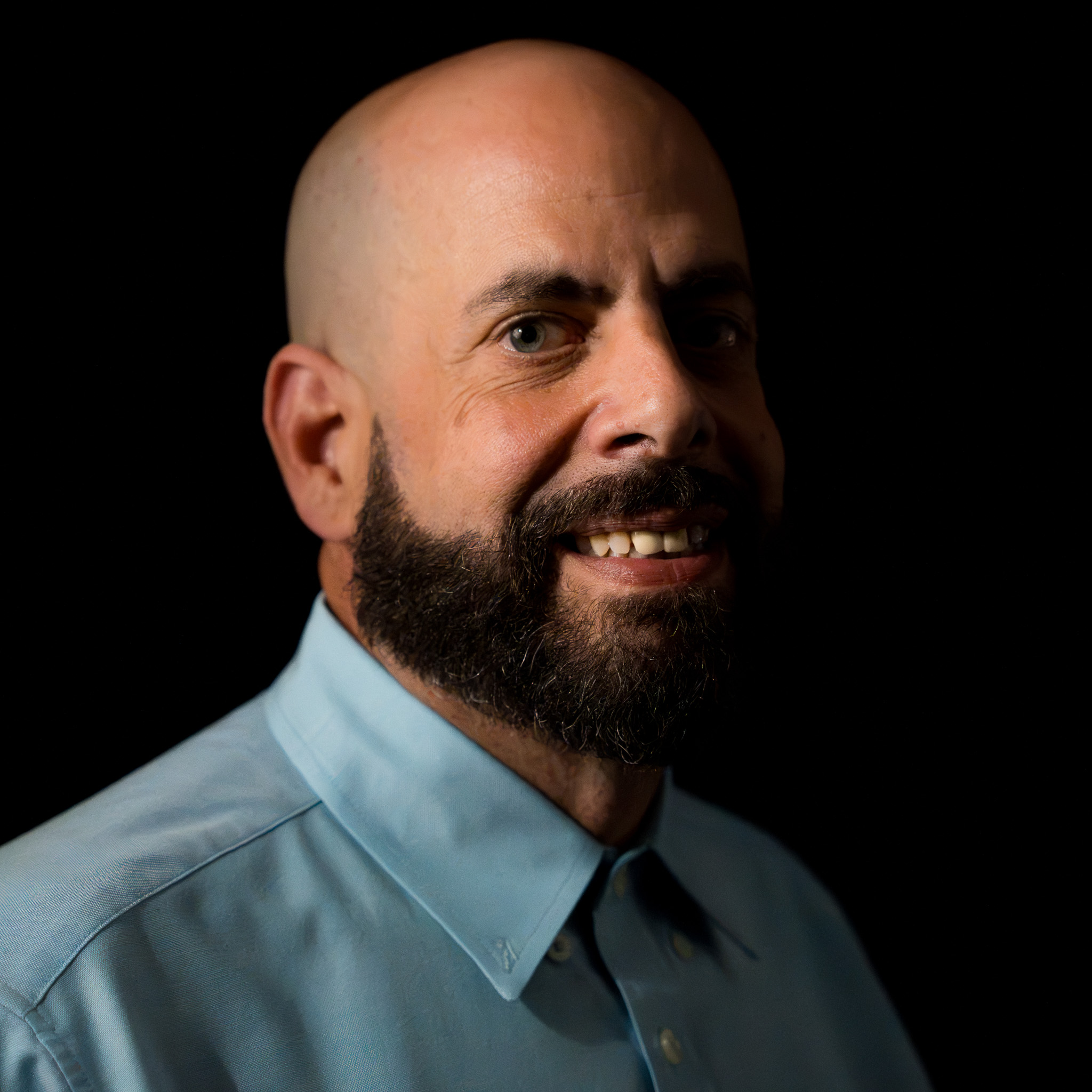
Some men arrive at Beit T’Shuvah in a car. Some arrive in a cab paid for by a mother who has run out of other ideas. Jason arrived straight from jail, in a paper suit. Not a jumpsuit you’d see someone wear in an 80s rap video or in The Sopranos. A paper suit—the disposable, tear-away, one-size-fits-no-one kind of suit. The type our country hands you when you’re out of clothes, prison, and dignity. But that didn’t stop Jason from picking himself up by his bootstraps, or where the straps would have been if his shoes had laces, and turning into a pillar of recovery in this community.
But we’re getting ahead of ourselves. Let’s rewind about 49 years, to a kid on a bike. Simpler times.
Jason was born in Texas—Harris County. He lived there for five years, but he’ll be a Texas boy forever. His parents brought him to North Hollywood, where he became what he’d be for the next four decades. A Valley Boy. His father was a machinist. His mother bounced between office jobs, plastic surgery centers, whatever came, and worked hard at all of it. They didn’t have much, but they gave him everything. “I was spoiled, but we didn’t have it like that. So they really looked out, did the best they could.”
He was, by his own accounting, a regular kid. Always on his bike. Always in the mud. He collected what he calls “bike friends.” A beautiful piece of specific childhood taxonomy meaning somebody who has a bike, and with whom you go looking for frogs and jumps. He pitched two no-hitters young enough that grown men accused him of doctoring the ball. He got suspended exactly once in his life, in sixth grade, for his role in what he can only describe as “the blow dart ring.” A schoolyard cartel of sewing needles and pen tubes that collapsed when a kid took one in the cheek. Portola Junior. Reseda High. That’s where he found architectural drafting. He loved it. He excelled at it. It propelled him to find love for his other classes as well. That year, he graduated with a 4.0.
“Should have stuck with that,” he says with 20/20 hindsight, “but I didn’t.” There is a version of this spotlight where that’s the whole story. The drafter. The builder. The pitcher. Instead, after graduation, Jason started hanging around local gang members in Reseda—guys he’d known before they were anybody. Back when being from the same block just meant the bike ride to each other’s houses was shorter. They wanted him to join—to jump him in. He said no. This is worth sitting with, because it is the first appearance of something that runs through his entire life like a spark through a live wire. Jason has always known exactly where he lies. He dodged that bullet, but spent the next several years standing directly next to the shooter.
The tagging came instead, and with it the stealing. He and his friends would mainly rob Rite Aids and Kmarts. “We’d go in there and put on as many dickies, pants and shirts as we could walk out like the kid on A Christmas Story.” His first arrest was for a bottle of clothing dye worth about a dollar twenty-nine. He got caught with a pullout stereo in his hand and a skate sticker on his Volkswagen that read, “Fucked.” And he was.
Jason didn’t smoke until eighteen—and here’s the part that should have been the warning. His father had weed, good weed, hydroponic before anyone was calling it that, and Jason would pinch a little to go get his friends high at the park. He’d pack them bowls and watch them cough. He’d laugh at them, but he wouldn’t partake. Not because he was afraid of it. Because he was afraid of becoming it. But becoming him it did. One night in his own room, a couple months after graduation, he decided to take a hit. It was love at first high. “Instantly. Instantly I was hooked.” Decades would go by before he put the pipe down.
With the lifestyle he was living came hard danger and high drugs. Or maybe it’s high danger and hard drugs. Who’s to say, because when meth was offered to Jason on a car ride down Victory Boulevard, he didn’t refuse. “It was the kind of biker meth that looked like peanut butter. It felt like my hair grew instantly.” This line was followed by a year of raves, acid, spray-painting his VW Bug a different color every week, ten cans at a time, mosh pits in a friend’s guest house and Big Gulps at 7-Eleven because that was the only thing his mouth could handle.
This all culminated in his biggest scam yet: cashing fake checks. He was cashing counterfeit checks for a guy in the Palisades—fifty thousand dollars’ worth, three and four grand at a time. Jason toured every Bank of America in Southern California. That is, until a teller took one to the back and Jason sat there, unaware of what was to come…until he heard the sounds. The thump of boots. The clanking of a duty belt. The unmistakable jingle of handcuffs.
The meth ended there. A stint in jail and thirty days in a work camp in Irvine picking strawberries. “A summer camp for idiots,” as he calls it. Then his mother, who is French, put her son on a plane to Paris for three months. That was the intervention. To an extent it worked. He never touched meth again. He did come, however, addicted to smoking hash.
Upon his return to the States came a new career. Dick Clark Productions at seventy-five dollars a day, standing starstruck in an office while Dick Clark sat in his boxers waving him in. “I guess that’s how he got his name.” Then three years at Playboy TV, which is where he met the art department guys who’d become his people. While working at Playboy, he became fascinated with the sound system and paid a guy a half pound of weed to teach him audio. Upon this grass he built his church—bouncing between the audio and art department for two decades, taking whichever job called first and paid more. Flavor of Love. Rock of Love. America’s Greatest Dog. Vans Warped Tour. The Family Stallone.
While at Dick Clark Productions, he met the woman who would later become his wife. In an effort to get off his friend’s couch, he asked her if she wanted to live together. That’s how the relationship started. They got married in 2003 when she became pregnant. He grew weed in apartments, then houses. He drove a tricked-out ’62 Impala Super Sport. “Nothing says drug dealer more than that.”
And through every bit of it, he was a father. He partied for 17 years and would party until his nose clogged, and then he’d announce that the party was over because he had personally finished it. “That was kind of like my mantra. Do as much as you can.”
Seventeen years of that. Then his kids told him their mother was divorcing him—his kids told him. It all came apart at once. Six months on a couch downstairs in the house they still shared. Then, just like that, she left with the clothes and the kids. Jason, now alone for the first time in almost two decades, smoking wax from five in the morning until ten at night, started to really examine where things had gone astray.
He’ll tell you, matter-of-factly, that he smoked more wax than a person should survive. A candle’s worth every week. It’s been a while since I smoked, but I imagine they measure weed wax in candles…right? He smoked so much that he stopped getting high. The period of it getting high had fallen into a period of maintenance—high maintenance.
A few years ago, a car turned left in front of him on Ventura, and he swerved into a dry cleaner’s. He bought a scooter, ate a half-ounce of mushrooms at a friend’s house, and broke his tibia turning onto his own street—then went back to the friend’s house and ate another half-ounce and sat there tripping on his own purple leg, asking, “Does this look all right?” It did not look all right. Cast on, unable to work, tripping on mushrooms, he heard a party two doors down and hobbled over there with a bat, a chain, and a broken leg to tell them to turn it down.
Red and blue lights. A five-year deal. Two strikes. Twenty-two months served, twelve of them in a wheelchair. High Desert Prison, pulling up on a bus in the snow, alarms going off every five minutes, which is how you know somebody is being stabbed.
You’d think that would be the bottom. It wasn’t. The bottom came in Lancaster, in his father’s house.
Understand: he and his father hadn’t spoken for ten years. Yet, he decided to move in with him. The reason they didn’t speak was truly heartbreaking. His dad would drive down from Lancaster to the Valley to buy weed from his son, and while he was there, a room away from his own grandchildren, he wouldn’t stay to see them. “I got to go back for traffic.” After too many times of this, Jason finally told him, “You’re not getting this weed, and don’t come back.”
Then one night, after he ate fourteen grams of mushroom gummies and the cat scratched him, his father came out of his room to quiet him down. Once you have ingested fourteen grams of mushrooms—an entree’s worth (or I suppose a dessert because they were gummies)—your best judgment is out the window. He heard 911 on his dad’s speakerphone, kicked in the door, and proceeded to hit his father, wrecked the house, and take his dad’s Corvette—the old man’s baby. After a few tire-burning donuts in the parking lot, he brought it back. Then the cops came, and he ran, and he jumped fence after fence through the neighborhood. “I felt like I jumped fourteen fences, but I was like three houses down in a cul-de-sac. Because of the heat, he took his shirt off and was dunking his head in strangers’ pools. Then, on the fortieth fence jump (or maybe the third) he landed to the sound of his leg popping like a gunshot. He had blown out his ACL. With no ability to flee any further, he came out with his hands up. “Don’t shoot! I’m high on fourteen grams of mushrooms!”
The mugshot they took that night—where he was told he couldn’t smile—had him, black-eyed, pupils like boulders, and an ear-to-ear Joker grin. But, that mugshot was actually his saving grace because it was clearly a portrait of a man who was so obviously out of his mind, high on drugs, that it is the reason he got drug court instead of ten years in prison.
Seven months in county waiting. Rotting. Until he heard the whisper of the words, “Beit T’Shuvah.” Baer came to interview him and delivered the bad news first: we met you in 2017, and we didn’t like you. Jason had smoked so much wax in the intervening years he had no memory of the interview at all—let alone that Beit T’Shuvah even existed. But Baer, always with the big heart, let him tell his story again. A month later, Carrie and Lily showed up like angels descending into hell to save a lost soul. “Slam dunk. We want you.”
What changed? “My life is going by fast, and I’m wasting it just getting high.” He remembers turning forty in that guest house in Encino, asking where it all went, and he could feel himself about to turn fifty and asking the exact same question.
He won’t ask it again.
In the days since Jason has walked into Beit T’Shuvah, draped in America’s best recyclable garments, the road hasn’t been peaches and rainbows. But, still, he has put his all into this program. Now, he is one of the most trusted residents in the building. He has an internship with the Film Department. “[Beit T’Shuvah] gave me the chance with a camera, which is one of my favorite passions. It’s something that’s therapeutic for me. To have a camera in my room, it’s like having the keys.” And may I say, as his boss, he is excellent with that camera. He’s got a real eye. One that few possess.
Jason expresses that the individualized nature of the program here is something that means a lot to him. From having a spiritual counselor to an addiction counselor to a therapist—for the first time in forty-nine years. “People pay a lot of money for this. I get to get stuff off my chest that I’ve had on there for a long time.” He has thrown himself fully into the program and finds more and more gratitude for it every day. “Beit T’Shuvah has given me the ability to grow, learn and have the opportunity to feel like a person instead of a paycheck.” And in a courtroom in Lancaster, a judge who had never heard of this place made a Josh G. (Alternative Sentencing intern and last week’s spotlight) teach her how to say it. Then she said it herself, “I’m very glad that Jason brought this program to life. We can use it more in our courts.”
Sit with that. A man arrives here with nothing but ten years hanging over his head, and within a few months he has become the reason the next desperate person in that same courtroom might hear the word redemption instead of the word prison. He knows what that’s worth. He also can’t quite get over the absurdity of it. “This place has been here for 40 years. How am I the Beit T’Shuvah poster child of Lancaster right now?”
But he deserves to be. Jason might be harder on himself than anyone ever should be, but even he can recognize that he has come farther in the last ten months than he did in the last ten years. And that’s a miracle. Not one created by Beit T’Shuvah. We don’t hammer the nail. We just provide the tools…and Jason has become a carpenter—an architect of his own future, drafting the blueprints of his recovery. The foundation is built. He’s broken ground. Now, it’s time for him to begin to build.